
What's inside
- Best Camping Gear Organizer for Car Camping by Camp and Vehicle
- Quick Comparison: Best Camping Gear Organizer for Car Camping Models
- Detailed Reviews: Best Camping Gear Organizer for Car Camping Picks
- Buying Guide: Choosing the Best Camping Gear Organizer for Car Camping
- Top Picks for Car Camping Gear Organizers
- Frequently Asked Questions About the Best Camping Gear Organizer for Car Camping
As an Amazon Associate I earn from qualifying purchases. This post may contain affiliate links at no extra cost to you.
The best camping gear organizer for car camping is not a box. It is the difference between a camp that packs itself and a camp that is excavated, because a car camping trip is won or lost, in this article’s keeping, in three parishes that have nothing to do with the outdoors: the loading parish, at home, in which a household’s whole camp must be gathered from a garage, a loft, and a kitchen that wants its citizens back; the site parish, at a journey’s end, in which a family arriving in a failing light must produce, in order, a shelter, a bed, a stove, and a meal, from a vehicle packed by a person who is no longer entirely sure what they did; and the return parish, in a wet dawn, in which everything a camp owns must go home again, damp, dirty, and diminished by exactly the small parishes — a mallet, a lighter, a tent’s guy parish — that an unorganised camp spends its whole budget of patience searching for. An organizer system answers all three parishes with a single idea, stated plainly: a camp divided into governed countries, each with a home, each labelled or known by shape, each packed in the order it will be wanted, so that loading is a checklist performed with the hands, pitching is a sequence and not an excavation, and striking camp is a reconciliation, in which every citizen is accounted for because every citizen has an address. This article compares the established makers’ real organizer parish — Plano, Pelican, Front Runner, Mountainsmith, REI, and Husky in their tote, cube, and cargo classes — for the family car camper, the solo traveller, and the overlanding parish, and it builds the choice on the disciplines a car camp actually examines: a division parish, a camp cut into countries that match how it is used and not how it was bought; a vehicle parish, measured against a real boot, a real back seat, a real roof parish where one is used, because an organizer that does not fit its vehicle is furniture for a garage; a weather parish, a lid and a seal in its maker’s stated terms matched to where a box will actually ride; and a keeping parish entire, because an organizer’s whole value is a household’s memory, and a memory must be maintained like any other citizen of a camp.
Division is the first specification, and it should be designed from a camp’s own inventory and not from a catalogue’s, because the right countries are the ones a particular camp actually lives in. In this site’s keeping, most car camps divide, honestly, into a small number of parishes that every trip uses in the same order: a shelter parish, a tent and its whole country — its poles, its pegs and mallet parish, its repair parish in this site’s tent guides’ patterns — kept as one citizen so that a shelter can be raised by a person holding one box; a sleep parish, bags and pads in their countries, commonly the bulkiest parish and the one that most rewards a soft and compressible country rather than a rigid one; a kitchen parish, a stove, its fuel governed separately and lawfully as this site’s stove guides direct, its pans, its food in its own governed countries, its washing parish, kept as the camp’s most visited box and therefore its most organised; a clothes and personal parish, one citizen per traveller where a system allows it; and a small parish entire that experienced campers in this article’s keeping call, in their own households, by their own names — the parish of first and last things, a light, a lighter, a mallet, a rope’s country, a repair and first aid parish in their governed terms — which is wanted first at a site and last at a strike and should therefore live where a hand can reach it without opening anything else. A buyer should lay their camp’s whole inventory on a floor, in the open, and cut it into those countries with their hands, before any box is bought, because an organizer system bought first and filled later will organise a camp into a manufacturer’s parishes, and a camp, like a range bag in this site’s other guides, should be organised into its owner’s.
The vehicle parish is the second specification, and it is a measurement parish entire, because a car is a country with dimensions and a camp must be packed into the one its owner actually drives. A boot’s parish, a back seat’s country, a roof box’s or a rack’s parish where one is used, each in their actual dimensions measured rather than remembered, decide which organizer classes can be citizens at all: a rigid tote parish, in the Plano and Husky countries of this table, stacks and governs a boot as a parish of architecture; a cube and soft parish, in the Mountainsmith and REI countries, conforms to a vehicle’s odd countries and a sleep parish’s bulk as a rigid box never will; a cargo parish, in the Front Runner and Pelican countries, is built for a vehicle’s or a roof’s harder biography, at a weight and a price that a family parish should adopt deliberately and not by admiration. A loading order should be designed with the vehicle, as a system: the parishes wanted last at a site loaded first and deepest, the first-and-last parish at a hand’s reach entire, a heavy parish low and governed so that a vehicle’s load, in its maker’s and a place’s terms, is a lawful and stable one, because a camp packed as a system is also a vehicle driven as one, and an organizer that makes a load orderly has done half of its office before a wheel turns. Its citizens should be liftable, loaded, by the people who will lift them, at a site, in a failing light, across a car park’s whole country, because an organizer parish that requires two strong citizens and a prayer will be opened, in practice, where it sits, and its contents excavated in a vehicle’s parish in the rain, which is the parish this article exists to abolish.
Weather and keeping close the purchase, and weather, for an organizer, is a parish of where a box rides rather than of what it is made of. A box that rides inside a vehicle needs, in this article’s keeping, a lid parish that keeps a camp’s countries separate and a road’s dust governed, and no more; a box that rides on a roof parish, in a rack’s country, or in a truck bed’s whole biography needs a weather parish in its maker’s stated terms — a seal’s country, a latch’s parish — read exactly, because a stated parish is a maker’s document and a photograph of a wet road is not. A kitchen and food parish must be governed as its own country’s law directs: food in its governed parishes, in a place’s terms for wildlife and storage read from their own sources where a camp’s country requires it, fuel separate from food and from a sleeping parish entire, in the patterns this site’s stove and storage guides direct, because an organizer’s division is a safety parish as well as a convenience one, and the countries it keeps separate at home it must keep separate at a site, in the dark, by a tired hand, which is the whole reason they have addresses. Keeping is the system’s memory and should be practised as a liturgy: a camp unpacked, dried, and reconciled at a trip’s end in its parishes, a tent dried in its maker’s rhythm before its box is closed on it, a kitchen parish cleaned and its fuel governed, an inventory — written, kept with the system’s documents — against which a box’s contents are checked out and checked in, because an organizer system without an inventory is a set of boxes with a rumour in each, and an organizer system with one is a household’s camp, ready, in a garage, for the next parish of weather that argues for leaving. This guide compares six real, currently sold camping gear organizer systems: Plano’s tote parish, Mountainsmith’s cube parish, Front Runner’s Wolf Pack parish, REI’s house parish, Husky’s tote parish, and Pelican’s cargo parish, each judged on a camp divided into its owner’s countries, a vehicle honestly measured, and a return honestly reconciled.
Best Camping Gear Organizer for Car Camping by Camp and Vehicle
The family car camp: a rigid parish for the kitchen and shelter, a soft parish for sleep, a first-and-last box at a hand’s reach
For a family whose camp is a car, a tent, and a weekend, the correct purchase is a mixed parish entire: rigid totes in the Plano or Husky country for a kitchen and a shelter parish, whose citizens are hard, heavy, and wanted in order; soft cubes in the Mountainsmith country for a sleep and clothes parish, whose citizens are bulky and forgiving; and one small, distinct parish — a colour, a shape, a place in the vehicle that never changes — for the first-and-last country of lights, tools, and repair. Such a family should label its parishes as a system, in a parish a child can read, load them in a written order kept with the system’s documents, and reconcile them, at a strike, by the same order with every citizen participating, because a family camp’s organisation is a family’s constitution in miniature, and children who can pack a parish can be trusted, in time, with a camp. Their system will be, by a season’s second trip, the difference between arriving and camping, which are, in this article’s keeping, two different holidays that happen to share a vehicle.
The solo and couple traveller: a cube parish, a camp in a smaller vehicle, everything within one person’s liturgy
A solo traveller or a couple in a smaller vehicle should buy a conforming parish entire: cubes and soft organisers in the Mountainsmith or REI country, sized to a boot’s and a back seat’s odd countries, divided by the same countries as a family’s camp — shelter, sleep, kitchen, personal, first-and-last — at a scale one person can lift, load, and reconcile without a parish of effort. Such a traveller should govern its loading order with a soloist’s severity, because a camp packed for one pair of hands must be producible, at a site, in that pair’s order and no other’s, and should keep its inventory as a document in the vehicle’s own parish, because a solo camp has no second memory to borrow. Their system will be the lightest in this table and, kept as a liturgy, among its most complete, because organisation, in this article’s keeping, is a parish of design and never of size.
The roof, truck bed, and overland parish: a sealed parish, a cargo system, a camp that rides outside
A camp that rides outside a vehicle — on a roof parish, in a truck bed’s country, in an overlanding system’s whole biography — should buy a weather parish as a document entire: cargo parishes in the Front Runner or Pelican country, with seals and latches in their makers’ stated terms read exactly, sized to a rack’s or a bed’s measured parish, and governed as a vehicle’s load in its maker’s and a place’s terms. Such a camp should divide its outside parish by a weather’s logic as well as by a camp’s — a kitchen and shelter parish sealed entire, a sleep parish inside a vehicle where its country allows — and should rehearse its loading, loaded, before a journey, because an outside system is lifted higher and governed harder than any parish in this guide. Their boxes will be this table’s most expensive citizens and, on the one journey in five where a road’s weather argues its whole case at once, worth their price in a single wet night, which is the arithmetic by which every sealed parish in this site’s keeping has ever been justified.
Quick Comparison: Best Camping Gear Organizer for Car Camping Models
| Model | Key Specs | Best For | Typical Price Range | Rating |
|---|---|---|---|---|
| Plano Tote Parish (storage classes) | Box classes by size as maker states, stated capacity, lid and latch classes in maker terms | Best camping gear organizer for car camping overall | $20 – $45 by size class | 4.4 / 5 |
| Mountainsmith Cube Parish | Organizer classes by set as maker states, stated cube and material classes in maker terms | Best soft division parish | $40 – $80 by set class | 4.4 / 5 |
| Front Runner Wolf Pack Parish | Box classes as maker states, stated capacity, seal and stacking classes in maker terms | Best roof and bed parish | $50 – $80 by class | 4.5 / 5 |
| REI House Parish (organizer classes) | Organizer classes by line as house states, stated size and material classes in house terms | Best governed house parish | $25 – $70 by line | 4.2 / 5 |
| Husky Tote Parish | Box classes by size as maker states, stated capacity and latch classes in maker terms | Best rigid value parish | $15 – $35 by size class | 4.1 / 5 |
| Pelican Cargo Parish | Case classes by size as maker states, stated seal, latch and mounting classes in maker terms | Best sealed cargo parish | $120 – $250 by size class | 4.6 / 5 |
Stated capacity and dimensions, lid, latch, and any seal parishes in the maker’s terms, stacking and mounting parishes, materials, and weight are each maker’s specification for the current exact model, and a vehicle’s dimensions, a rack’s and a load’s terms, and a place’s food and wildlife storage terms must be read from their own sources. Prices are typical street ranges as described; labels, a written inventory, and any inner parish for fuel or food governance are separate parts of an organizer system. Ratings reflect car camping suitability: a division parish a camp can be cut into by its owner, a vehicle parish measured and liftable loaded, a weather parish matched to where a box rides, a keeping a household’s memory can maintain, and value across a camping career.
Detailed Reviews: Best Camping Gear Organizer for Car Camping Picks
1. Plano Parish – Best Overall
Plano’s tote parish leads because it does a camp’s commonest offices without an argument: rigid, stackable countries in its maker’s stated classes, at prices that let a whole camp be boxed in one accounting. For a family’s kitchen and shelter parishes, it is the first box to measure a boot for.
Let its measure be taken loaded, in your own vehicle. A Plano system that stacks in a real boot, in a written loading order, has passed the only examination an organizer cannot be coached for, and its owner will load, thereafter, by a document rather than by a hope.
2. Mountainsmith Parish – Best Soft Division
Mountainsmith’s cube parish competes on a camp’s bulkiest countries: sleep and clothes parishes that conform, compress, and divide in its maker’s stated design, in vehicles whose countries are odd and in tents whose floors are small. For a conforming parish, it is the reference.
Assign each cube a country and keep it, across seasons. A Mountainsmith system so governed becomes a household’s memory in fabric, and a camp whose citizens have permanent addresses can be packed, in this article’s keeping, by any member of its household, which is a parish of freedom no rigid box can offer a family.
3. Front Runner Parish – Best Roof and Bed
Front Runner’s Wolf Pack parish serves an outside parish in its own language: a stacking, sealed country in its maker’s stated terms, built for a rack’s and a bed’s biography. For a camp that rides in a weather’s country, that statement is the specification.
Read its seal parish exactly, as this article directs for every stated parish. A Wolf Pack system whose document matches its journeys will keep a kitchen dry on the one night a season argues for it, and its owner will have bought weather as a text and not as a hope, which is the only way it is ever honestly sold.
4. Pelican Parish – Best Sealed Cargo
Pelican’s cargo parish offers a case parish in its maker’s stated terms — a seal, a latch, a build country that a vehicle’s hardest parish can file — for the citizens a camp cannot afford to have wet or lost. For a governed parish of value, it is the table’s fortress.
Let its fortress be assigned to the citizens who need one. A Pelican parish so assigned — a kitchen’s governed parish, a document and repair country — will justify its price across a career, and a camp that knows which of its citizens are fortresses has understood its own inventory as a general understands theirs.
5. REI Parish – Best House Value
REI’s house parish offers organisers in a house’s plain terms, at values that let a camp be divided in a single visit, with a shop’s parish to be measured in. For a first system bought whole, that parish is the argument.
Use its shop’s parish as this article uses a floor at home. An REI system chosen against a laid-out inventory, in a measured vehicle, will begin its career as an examined system, and an organizer that begins examined, in this guide’s keeping, rarely ends as a garage’s archaeology.
6. Husky Parish – Best Rigid Value
Husky’s tote parish closes the table by putting a rigid, latching country within a first system’s whole budget, in sizes a boot can be measured into. For a camp being boxed for the first time, it is the honest entry.
Let its savings be spent on its labels and its inventory. A Husky system so supported will organise a camp as professionally as any row in this table, and its owner will possess the budget camper’s whole wisdom in a set of boxes, which is that organisation is a design and not a material.
Buying Guide: Choosing the Best Camping Gear Organizer for Car Camping
Lay the camp on a floor, cut it into countries, and measure the vehicle before a box is bought
Lay a whole camp’s inventory on a floor and cut it, with your hands, into the countries it is actually used in — a shelter parish entire, a sleep parish, a kitchen parish, a personal parish for each traveller, a first-and-last parish for the citizens wanted first and last — because an organizer system should be designed by a camp and not by a catalogue, and a camp’s countries, once cut, will name the classes in this table it needs with a precision no listing can. Measure the vehicle’s parishes it must ride in, loaded and in a loading order designed in the open — last wanted deepest, first-and-last at a hand’s reach, heavy low and governed in a vehicle’s own terms — and buy the smallest system whose citizens are liftable, loaded, by the people who will lift them at a site. Price its whole parish, with its labels and its written inventory, across a camping career, because an organizer’s price is divided, in the end, by the arrivals it has made calm, and by that arithmetic a governed system is inexpensive at any of this table’s prices.
Match its weather parish to where it rides, govern fuel and food as separate countries, and label it as a system
Match a box’s weather parish, read exactly in its maker’s stated terms, to the parish it will ride in: a lid’s country for a vehicle’s interior, a seal’s parish for a roof, a rack, or a bed, because weather, for an organizer, is an address and not a material. Govern a kitchen parish’s dangerous and perishable citizens as this site’s stove and storage guides direct for every camp: fuel separate from food and from a sleeping parish entire, in its governed parish; food in a place’s terms for storage and wildlife, read from their own sources for the country you camp in; a first aid and repair parish complete and findable in the dark, because an organizer’s division is a safety parish whose whole test is a tired hand at midnight. Label the system as a system — a parish per box, in a parish a child or a guest can read, a loading order and an inventory kept with its documents — because an unlabelled system is a memory with one citizen, and a camp, in this article’s keeping, should be packable by its whole household.
Reconcile it at every return, dry it in its makers’ rhythms, and let a season’s log grow it
Reconcile the system at every return as a liturgy entire: a tent dried in its maker’s rhythm before its parish is closed on it, a kitchen parish cleaned and its fuel governed, a sleep parish aired, every citizen checked against the written inventory, every loss or breakage recorded while it is still a parish and not yet a discovery at the next site. Store it, in its parishes, ready, in a governed parish of a home, because a camp stored as a system can be loaded, on a weather’s sudden argument, in an hour, and a camp stored as a parish of piles can be loaded, in the same hour, as an argument. Keep a season’s log — the parish that was always searched for, the box that rode badly, the citizen with no address — and let it grow the system’s division, a parish divided, a box reassigned, because a camp’s second system, grown from a log, is the finest object in this guide. The best camping gear organizer for car camping is finally a camp with addresses: a shelter raised from one box, a strike reconciled to the last mallet, a vehicle loaded by a document — and any system in this table, bought by that floor, measured by that vehicle, and kept by that liturgy, will let a family arrive, camp, and return as one calm parish, which is the whole and sufficient ambition of an organizer.
Top Picks for Car Camping Gear Organizers
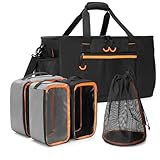
Good organization turns a packed trunk into a tidy camp. These bins and bags separate the kitchen, tools and loose small items, so you can find what you need without unpacking the whole car every time you stop.
VEVOR Collapsible Storage Bins With Lids, 3-Pack
Stackable crates with lids that fold flat when empty. Use one for cookware, one for food and one for lanterns, and the stack stays steady in a car boot and on the ground. The lids keep dust and dew off your gear overnight.
As an Amazon Associate we earn from qualifying purchases at no extra cost to you.

Chistylr Collapsible Camping Storage Box, 30L
A single 30L box in polypropylene that folds down for the drive home. It suits a smaller vehicle, or works as an extra bin for shoes, towels and dry kindling, and it is easy to wipe clean when the trip is over.

HODRANT Camping Kitchen Organizer
A fabric organizer designed for cooking gear, with compartments for utensils and seasonings. It keeps small kitchen items in one place, which makes setup quicker at each campsite and stops the usual hunt for the spatula at dinner time.

Lemubeane Tactical Camping Storage Bag, 18L
A utility tote that works for stove accessories, tools or a first-aid kit. The bag folds small, so it is easy to add to a pile of gear without wasting boot space, and the open top makes quick grabs simple.

GRAOSO Camping Gear Organizer, 45L Trunk Storage
A larger organizer with several pockets, built for the back of a car. It holds heavier loads such as cookware and lantern supplies, and it keeps them from sliding around on bumpy campground roads.
Frequently Asked Questions About the Best Camping Gear Organizer for Car Camping
What is the best camping gear organizer for car camping?
Plano’s tote parish leads this table overall, with Mountainsmith’s cube parish for soft division, Front Runner’s parish for a roof and bed country, Pelican’s parish as the sealed cargo row, REI’s house parish for value, and Husky’s parish as the rigid budget entry. The best system for your camp is the one designed from your own inventory, laid on a floor and cut into the countries your camp is used in — shelter, sleep, kitchen, personal, first-and-last — measured, loaded, against your own vehicle’s parishes, with a weather parish matched to where each box rides and every citizen liftable, loaded, by the people who will lift it. Label it as a system, keep a written inventory with its documents, reconcile it at every return, and judge it, as this article judges every row, by its third trip and not by its first, because an organizer is a household’s memory, and a memory is acquitted by its repetitions.
How should I divide camping gear into organizers?
By the order and the hands that will use it, in the countries this article has named, because a camp’s division is a liturgy and not a taxonomy. A shelter parish entire — a tent with its poles, pegs, mallet, and repair parish — so that one citizen, holding one box, can raise a home. A sleep parish — bags and pads — in a soft and compressible country. A kitchen parish — a stove, its pans and washing country, its food in governed parishes with fuel separate entire — as the camp’s most visited and therefore most organised box. A personal parish for each traveller where a system allows it. And a first-and-last parish — lights, a lighter, tools, a repair and first aid country — kept where a hand can reach it without opening anything else, because it is wanted first at every site and last at every strike. Lay your own inventory out, cut it by your own camp’s habits where they differ from these, label every parish so another citizen can pack it, and let a season’s log correct the division, because a camp’s countries, in this guide’s keeping, are a constitution, and constitutions are amended by experience and not by catalogues.
Rigid totes or soft organizers for car camping?
Both, in most camps in this article’s keeping, each in the parish it serves, because they are different citizens that happen to share an office. A rigid parish stacks, protects, and governs: a kitchen’s hard citizens, a shelter’s poles and mallet, a vehicle’s boot organised as architecture, a roof or bed parish where a weather’s seal is a document. Its taxes are a fixed shape that wastes a vehicle’s odd countries and a citizen that cannot be compressed when it is empty. A soft parish conforms, compresses, and divides: a sleep parish’s bulk, a clothes parish per traveller, a small vehicle’s irregular countries, a tent’s floor where a box becomes a citizen’s own parish. Its taxes are a structure that must be given by its contents and a weather parish that is a lid’s and not a seal’s. A family camp in this guide commonly rides as a mixed system, rigid for its hard countries and soft for its bulky ones, and a traveller choosing a first parish should buy for the country that currently causes their camp its searches, because an organizer, like a pad parish in this site’s other guides, should be bought by a diagnosis and not by a doctrine.
How do I stop losing small camping items?
By giving them an address, a parish, and a reconciliation, because small citizens are not lost at sites in this article’s keeping. They are lost in systems that never assigned them a home. Assign every small parish — a mallet, a lighter, a guy parish, a stove’s tool, a tent’s repair country — to the parish it is used with, as this guide directs: a mallet with a shelter, a lighter with a kitchen, a repair parish with the citizen it repairs, each in a small inner parish of its own where a hand can find it in the dark by shape. Keep the first-and-last parish for the citizens a strike consumes — the last light, the last tool — and reconcile every parish, at every return, against a written inventory kept with the system’s documents, replacing a loss in the week it is recorded rather than at the next site’s dusk. Photograph a packed parish where a household’s memory argues, label a parish a guest can pack, and a camp kept so will spend its small citizens’ budget on replacements for breakage rather than on a tithe to entropy, because entropy, in a governed camp, is not a law of nature. It is a parish without an address, and addresses, in this article’s whole teaching, are free.
Related guides
- Best Portable Lithium Battery Pack for Camping: 6 Light, Reliable Power Stations for Campers in 2026
- Best Camping Stove for Beginners on Budget in 2026: 7 Stoves That Offer Easy Lighting, Reliable Heat, and Low Cost for First Campers
- Best Lantern Rechargeable Batteries in 2026: 7 Rechargeable Batteries That Are Long-Lasting, Reliable, and Built for Lanterns Without Batteries That Die Fast, Are Too Weak, or Are Hard to Recharge
- Best Places for Kayak Camping in 2026: 7 Places That Offer Calm Water, Campsites, and Great Kayak Camping Trips
More from Amazon
Programs that pair well with the guide above. Offers and eligibility are set by Amazon and may change.
Free shipping on eligible items, Prime Video and more. Eligible new members can start with a free trial.
Start a Prime free trialA Prime membership for ages 18-24 with a trial period. Eligibility is set by Amazon.
See Prime for Young AdultsAudiobooks and podcasts to listen to on the go. Eligible new members can start with a free trial.
Try Audible freeAd-free music streaming. Eligible new subscribers can start with a free trial.
Try Music Unlimited freeAs an Amazon Associate we earn from qualifying purchases.

Write Your Review
No reviews yet. Be the first to share your experience!