
What's inside
As an Amazon Associate I earn from qualifying purchases. This post may contain affiliate links at no extra cost to you.
The best kayak cart for camping earns its money in the least glamorous part of the trip: the distance between the car and the water, walked with a boat that is suddenly much heavier than it was in the shop. A camping kayak is not an empty kayak. It carries a tent, a sleep system, days of food, water, and the small civilisation of a camp, and even on a car-camping trip where the boat launches beside the site, there is a campground path, a gravel spur, a grass slope, or a sandy beach between the parking place and the launch. Dragging a loaded hull across any of them damages the boat, exhausts the camper, and turns the first hour of the trip into an argument. A kayak cart turns that portage into a walk: the boat balanced over an axle, the weight carried by wheels instead of shoulders, one hand on the bow handle and the day starting the way it was supposed to. This guide compares real, currently sold carts from Suspenz, Wilderness Systems, Malone, Railblaza, and Seattle Sports across the two designs that matter — the plug-in scupper cart that locates through a sit-on-top’s scupper holes, and the cradle or bunk cart that straps under any hull — and across the wheel choice that decides where a cart can actually go.
Budget camping shapes the advice throughout, because this site’s readers outfit whole trips, not single products. A cart is a force multiplier for a cheap boat: an entry-level kayak that its owner can move alone, loaded, without a second person’s help or a roof-rack wrestling match at the water’s edge, gets used twice as often as a better boat that is a chore to launch. The carts in this table run from genuinely inexpensive strap-on models to one premium heavy-duty answer for big fishing kayaks, and the buying guide will be honest about where the money shows — in wheels that do not puncture or fold, in frames that do not flex under a loaded boat, and in straps and padding that hold a hull without marking it. Water safety frames the whole subject, as it should on this site: a cart gets you to the water, and what happens next is governed by the unchanging rules — a properly fitted life jacket worn, not carried, a float plan left with someone ashore, weather and water conditions checked before launching and respected when they change, cold water dressed for rather than hoped about, and no alcohol in the boat’s day. The best cart in this table is the one that makes launching easy enough that none of those preparations ever feel like the hard part.
Our Top Picks
What Makes the Best Kayak Cart for Camping Different
Scupper Carts vs Cradle Carts: Fit Is the First Decision
A scupper cart’s posts pass up through a sit-on-top kayak’s scupper holes, which locates the boat positively, needs no straps, and sets up in seconds — when it fits. Scupper spacing and diameter vary between boat models, an adjustable or model-matched cart is essential, and the posts must fit without being forced, because a scupper hole is a moulded part of the hull and prying at it with an ill-fitting post can crack the very structure that keeps the boat watertight. Cart makers state their fit ranges and adjustable patterns in their own terms; measure your boat’s scupper spacing and hole size and buy against those numbers, not against a photograph of a similar kayak. A cradle or bunk cart takes the universal path: padded bunks or a shaped frame sit under the hull, a strap or two secures the boat, and the same cart serves a sit-inside, a sit-on-top, a canoe at a pinch, and next year’s different boat. It takes a minute longer to load, it can shift if strapped carelessly, and it fits the camping reality of households with more than one hull and friends with more than two. For a single sit-on-top kept for years, a well-fitted scupper cart is the slickest tool in this guide. For everyone else — and for every borrowed, rented, or second boat — the cradle is the honest default, and the table is weighted accordingly.
Wheels Decide Where You Can Actually Go
Every cart rolls beautifully across the car park in the product video. The wheel choice decides what happens at the car park’s edge. Standard hard or foam-filled wheels are light, cheap, puncture-proof in their solid forms, and entirely adequate for pavement, hard gravel, and short, firm paths — which describes a great many campground launches, and is why the value rows in this table wear them. Wide, low-pressure balloon wheels are the sand and soft-ground answer: they float a loaded boat across a beach and over soft grass where a narrow wheel digs in and stops, at the cost of size, weight, and price, and they are the single most destination-specific purchase in this guide. Pneumatic wheels roll smoothly and cushion a load over rough ground and roots, and carry the puncture risk their design implies, which a camping trip answers with a small repair kit or a spare tube in the car. Judge by your launches, honestly listed: the state park with a concrete ramp, the reservoir with a gravel path, the river access with forty yards of sand. Buy the wheel for the softest surface you genuinely use, because a cart that fails at the beach fails completely, and a balloon-wheeled cart bought for a concrete ramp is money and bulk spent on a surface that never asked for them.
Capacity, Balance, and Packing the Cart Itself
A cart’s stated load capacity, in the maker’s terms, must cover the boat as you will actually move it: hull weight plus the camping load you intend to roll rather than carry, with margin, because a cart at its limit flexes, wanders, and sheds straps on a slope. Balance matters as much as capacity. The cart belongs near the boat’s centre of weight, adjusted until the bow handle carries a light, comfortable downward or neutral load in your hand — a boat balanced on its cart can be walked a quarter mile with two fingers of effort, and a boat balanced badly is a wrestling match with wheels. Finally, the cart itself must pack. Camping cars are full, and the better carts here fold flat, pop their wheels off without tools, or stow inside the boat’s hatch or on its deck for the paddle to a waterside camp — a feature worth real money on a kayak-camping trip where the cart must travel in the boat and cannot be left at a launch you will not return to. Check the folded size against your hatch or your car before you buy, and practise the fold at home, because a cart that is fiddly to collapse will be left behind, and a cart left behind is a drag across the beach, literally.
Quick Comparison: Best Kayak Cart for Camping Models
| Model | Type, Wheels and Key Specs | Best For | Typical Price Range | Rating |
|---|---|---|---|---|
| Suspenz Smart Airless DLX class | Cradle cart, airless tyres in maker’s terms, adjustable padded bunks, folds flat class, stated capacity for mid-size kayaks | Best kayak cart for camping overall | $110 – $150 | 4.6 / 5 |
| Wilderness Systems Heavy Duty Kayak Cart class | Cradle cart, large airless or pneumatic wheel options in maker’s line, high stated capacity for loaded fishing kayaks, adjustable width | Best for heavy, loaded fishing and camping kayaks | $180 – $240 | 4.6 / 5 |
| Railblaza C-Tug class | Cradle cart, tool-free breakdown in maker’s design, puncture-free wheels, sand-friendly wide wheel option in maker’s line, packs into hatch class | Best for kayak-camping trips where the cart travels in the boat | $130 – $170 | 4.5 / 5 |
| Malone Clipper and Nomad class | Cradle carts in maker’s line, airless tyre class, folding frame, strap included, mid-range capacities in maker’s terms | Best value cradle cart | $80 – $120 by model | 4.3 / 5 |
| Seattle Sports ATC and Paddleboy class | Cradle carts in maker’s line, large wheel options for rough ground in class, high stated capacities, sturdy frames | Best for rough campground terrain | $120 – $180 by model | 4.3 / 5 |
| Suspenz Stowable Scupper Cart class | Scupper-post cart for sit-on-tops, adjustable post width in maker’s terms, airless wheels, compact stow | Best scupper cart for a single sit-on-top | $90 – $130 | 4.4 / 5 |

VEVOR Kayak Cart, 280 lbs Capacity, 10 in Solid Tires, Detachable Trolley | For Kayaks with Drain Holes of 2.54 cm and Above, Heavy-Duty Flexible Cart with Adjustable Width & Top Foam Protection, Black
As an Amazon Associate we earn from qualifying purchases. Product prices and availability are accurate as of the date/time indicated.

HIKEMOON 150L Collapsible Wagon Compact with Big Wheels, 420LBS Black | Wagons Carts Foldable, Heavy Duty, Portable, All-Terrain, Utility Folding Cart for Shopping/Garden/Camping/Sports
As an Amazon Associate we earn from qualifying purchases. Product prices and availability are accurate as of the date/time indicated.
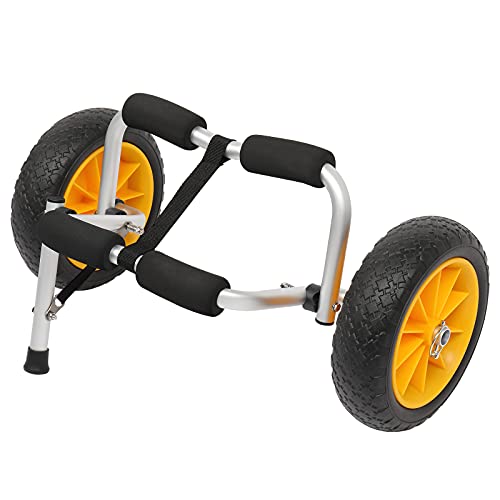
Bonnlo Foldable Kayak Cart, Lightweight Aluminum Alloy Frame, Universal Dolly Cart with 10'' Durable Solid Tires for Canoes, Paddle Boards, Boats, Strong 1.75" Thick Prongs
As an Amazon Associate we earn from qualifying purchases. Product prices and availability are accurate as of the date/time indicated.
Load capacities, wheel types and sizes, frame materials, folded dimensions, and fit ranges are each maker’s stated details for the current version. Scupper carts must be matched to your boat’s measured scupper spacing and hole diameter against the maker’s stated fit range; never force a post into a scupper hole. Load your boat and gear within the cart’s stated capacity and the kayak’s own stated capacity, whichever is reached first. Prices are typical retail ranges and vary by wheel option, retailer, region, and promotion. Ratings are editorial for camping use: fit and security of the loaded carry, wheel performance on campground surfaces, fold and stow practicality, build quality at working loads, and value in class.
Detailed Reviews: Best Kayak Cart for Camping Picks
1. Suspenz Smart Airless DLX Class – Best Overall
Suspenz built its name on carts that treat the boat gently and the owner kindly, and the DLX pattern is the camping all-rounder: padded, adjustable bunks that cradle a hull without point loads, airless tyres that cannot puncture on a thorn or a shard at the launch, a frame that folds flat for the car, and a stated capacity that covers the ordinary camping kayak honestly loaded. It loads without drama, balances where you put it, and its straps and padding survive seasons of grit. For the single-cart household with a normal boat and normal launches, this is the recommendation the rest of the table is measured against.
2. Wilderness Systems Heavy Duty Class – Best for Heavy Loaded Boats
Big fishing kayaks, loaded for camping, are the loads that fold lesser carts, and Wilderness Systems’ heavy-duty cart is built for exactly that weight class: a wide, adjustable stance, large wheels in the maker’s options, and a stated capacity with real margin for a hull, a drive system, tackle, and camp kit. It is the biggest and dearest cart here, and on a light recreational boat it is pure surplus. On a heavy one it is the difference between a cart that works and a cart that is technically present. Match the tool to the load and this row justifies itself every trip.
3. Railblaza C-Tug Class – Best When the Cart Travels in the Boat
The C-Tug’s party trick is disappearance: it breaks down without tools into pieces that stow in a hatch or a car corner, which makes it the kayak-camper’s cart, the one that can launch from a car, ride in the boat to a waterside camp, and carry the loaded boat up the bank at the far end. Its cradle design fits a wide range of hulls, its standard wheels are puncture-free, and a wide sand wheel option in the maker’s line extends it to beaches. Assembly is a small ritual worth practising at home. For point-to-point trips, nothing else in the table does its job.
4. Malone Clipper and Nomad Class – Best Value
Malone’s cradle carts bring the essential specification — folding frame, airless tyres, included strap, honest capacities — down to the prices budget camping runs on, in a build that serves ordinary launches without complaint. Refinement in the bunks, straps, and finish sits a step below Suspenz, felt in the third season rather than the first trip. For a first cart, a second household cart, or the cart that lives with a second boat, the value is exactly where this site likes it: in the seasons of use, not in the unboxing.
5. Seattle Sports ATC Class – Best for Rough Terrain
Seattle Sports’ carts lean toward the rougher end of campground geography, with larger wheel options in the maker’s line that roll over roots, ruts, and coarse gravel that stop smaller wheels, and frames rated for serious loads. If your launches involve a trail rather than a path — the walk-in lake, the river access down a bank — the wheel diameter in this row is the specification that decides your day. It packs less flat than the leaders, which is the honest price of its wheels, and for the campers whose ground demands them, it is a price correctly paid.
6. Suspenz Scupper Cart Class – Best for One Sit-On-Top
For the household with a single sit-on-top kayak kept for years, a fitted scupper cart is the fastest launch in this guide: posts in, boat up, walk away, no straps to tension and nothing to shift. Suspenz’s adjustable pattern covers a range of scupper spacings in the maker’s stated fit terms, and its airless wheels and compact stow complete a tidy tool. Its condition is the section above, in full: measure your boat, buy to the fit range, never force a post. Fitted correctly, it is a delight. Fitted approximately, it is a hull repair, and the difference is a tape measure.
Buying Guide: Choosing the Best Kayak Cart for Camping
Measure the Boat, List the Launches, Then Choose
Three facts choose the cart. Your boat: its type, sit-on-top or sit-inside, its hull weight, and — if you are considering a scupper cart — its measured scupper spacing and hole diameter, taken with the boat in front of you. Your load: the weight of the boat as it will actually roll, with the camping kit you intend to move in it rather than carry, checked against the cart’s stated capacity with margin to spare. Your launches: every surface between a car and water in your real season, with the softest and roughest of them named, because they choose the wheels — airless standard for pavement and firm paths, large diameter for rough ground, balloon for sand. Add the packing fact — must the cart fold into a full car, or travel inside the boat on a point-to-point trip — and the table reduces itself to one or two rows. Buy those, from a seller whose returns you have read, and test the loaded carry in the driveway before the first trip: balance point found, strap routine settled, fold practised. A cart proven at home is a launch that takes three minutes at the lake.
Load, Balance, and Roll: The Technique That Makes Any Cart Good
Even the best cart carries badly when it is loaded badly, so learn the small technique. Load the boat before the cart wherever the ground allows — kit packed low and centred in the hull, heavy items over where the cart will sit — then lift the boat onto the cradle or posts at its balance point, a little behind the middle for most hulls, and adjust until the bow handle’s weight in your hand is light. Strap a cradle cart through the frame and over the hull as the maker directs, snug enough that the boat cannot shift on a slope, never so hard that the hull deforms; a second strap is cheap insurance on rough ground. Walk a loaded test across grass and gravel before trusting a beach or a bank, keep your speed walking speed, lift the bow over kerbs and roots rather than ramming them, and on a slope, keep the boat below you and your body out of its downhill path. At the water, unload in the shallows or at the edge as the launch allows, rinse grit and sand from the cart’s axle and moving parts before it goes back in the car — sand in a folding joint is next trip’s failure being scheduled — and stow the cart where the day’s plan says: in the car, in the hatch, or strapped on deck, never loose where it can slide into the water or another camper’s path.
Care, Spares, and the Camping Habits Around the Cart
A cart asks little and repays it. Rinse it after salt and sand, dry it before storage, check strap webbing and buckles for the fray that grit guarantees, and keep pneumatic tyres at their maker’s stated pressure with a tube or repair kit in the car’s kit if your wheels use them. Carry the small spares that end small failures: a spare strap, the pin or clip your model’s wheels and frame depend on, and a length of cord that has improvised more camp repairs than any tool in the car. Around the cart, keep the camping disciplines that make the launch the easy part: life jackets fitted and worn by everyone who paddles, the boat loaded within its own stated capacity as well as the cart’s, a float plan and a weather check as unbreakable habits, and the camp itself — tent, food stored properly away from wildlife, and the shoreline left clean — run to the standard this site teaches across its guides. Do all of that, and the best kayak cart for camping becomes invisible in the best way: the boat simply arrives at the water, loaded, undamaged, with a camper fresh enough to enjoy it, which was the entire point of the wheels.
Frequently Asked Questions About Best Kayak Cart for Camping
What is the best kayak cart for camping?
The Suspenz Smart Airless DLX class is the best all-round answer for its padded adjustable cradle, puncture-proof airless tyres, flat fold, and honest capacity. The Wilderness Systems Heavy Duty is the pick for heavy, loaded fishing kayaks, the Railblaza C-Tug for trips where the cart must break down and travel in the boat, the Malone class for value, and a fitted Suspenz scupper cart for a single sit-on-top kept long-term. In every case the best is the cart whose stated capacity covers your boat loaded as you will roll it, whose wheels match the softest surface on your real launch list, and whose folded size fits your car or your hatch — proven in a loaded driveway test before the first trip.
Should I buy a scupper cart or a cradle cart?
Buy a scupper cart only if you have one sit-on-top kayak, you have measured its scupper spacing and hole diameter, and the cart’s stated fit range covers those measurements exactly. Fitted correctly, it is the fastest, strap-free carry in this guide. Buy a cradle cart for everything else: sit-inside kayaks, multiple or changing boats, borrowed and rented hulls, and any situation where the fit cannot be verified. A cradle’s padded bunks and straps fit the hull you have rather than the hull in a photograph, and they cannot crack a scupper hole, because they never touch one. Never force a scupper post that resists; a tight post is a warning, not a challenge, and a cracked scupper is a hull repair that costs more than any cart in this table.
What wheels do I need for sand and soft ground?
Wide, low-pressure balloon wheels are the sand answer: their broad footprint floats a loaded boat across soft sand and grass where standard wheels dig in, stop, and turn the carry into a drag. If your launches are beaches or soft riverbanks, choose a cart whose maker offers a balloon wheel option and budget for it as part of the cart, not as an upgrade to postpone. For pavement, concrete ramps, and firm gravel, standard airless wheels are entirely sufficient, lighter, cheaper, and puncture-proof. For rough, rooty, rutted ground, large-diameter wheels matter more than width, rolling over obstacles that halt small wheels. The rule is to buy for the softest and roughest surface you genuinely use, and to be honest about the list — most campground launches are firmer than campers fear, and the state park ramp has never once required a balloon wheel.
Can I take a kayak cart on a kayak-camping trip in the boat?
Yes, if you choose a cart designed to break down or fold small, and you plan its place in the boat before you launch. The Railblaza C-Tug class is built for exactly this, disassembling without tools into pieces that fit a hatch, and several folding cradle carts stow on a rear deck under bungees. Confirm the stowed cart still leaves the boat within its stated capacity and properly balanced, with the cart secured so it cannot shift or be lost in a capsize, and practise the pack at home with the full camping load aboard. On a point-to-point trip the cart earns its passage twice, once at each end. On a there-and-back trip from one launch, leaving the cart locked in the car is usually the simpler seamanship, and there is no prize for carrying equipment the trip does not use.
Related guides
- Best Lithium Battery for Camping in 2026: Lithium Battery for Camping, Lithium Camping Batteries, and Best Camping Batteries
- Best Camping Kayaks Under 500 in 2026: 7 Best Camping Kayaks Under 500 Dollars That Are Stable, Roomy, and Built for Camping
- Best Stove for Kayak Camping in 2026: 7 Best Stoves for Kayak Camping That Are Light, Compact, and Boil Fast
- Best Kayaks for Kayak Camping in 2026: 7 Best Kayaks for Kayak Camping With Clear Paddling, Simple Use, and Easy Use for Kayaks for Kayak Camping
More from Amazon
Programs that pair well with the guide above. Offers and eligibility are set by Amazon and may change.
Free shipping on eligible items, Prime Video and more. Eligible new members can start with a free trial.
Start a Prime free trialA Prime membership for ages 18-24 with a trial period. Eligibility is set by Amazon.
See Prime for Young AdultsAudiobooks and podcasts to listen to on the go. Eligible new members can start with a free trial.
Try Audible freeAd-free music streaming. Eligible new subscribers can start with a free trial.
Try Music Unlimited freeAs an Amazon Associate we earn from qualifying purchases.

Write Your Review
No reviews yet. Be the first to share your experience!