
What's inside
As an Amazon Associate I earn from qualifying purchases. This post may contain affiliate links at no extra cost to you.
The best touring kayak for camping is the boat that still handles like a kayak after you have put a weekend inside it. Kayak camping loads a hull with thirty to fifty pounds of shelter, food, water, and clothing, packed low in hatches fore and aft, and that load rewrites the boat: a kayak that felt nimble empty wallows, a kayak that tracked straight empty weathercocks in a crosswind, and a cockpit that swallowed the paddler at the shop becomes a negotiation once the dry bags are in. Touring kayaks earn the name in exactly this condition, with the length to carry speed between campsites, the hatch volume and bulkheads to swallow gear and to float the boat swamped, and the hull manners to cross a lake’s afternoon chop with a load aboard. This guide compares six real, currently sold touring and crossover kayaks graded for camping specifically, from the recreational-touring boats that carry most campers to the sea-capable hulls for exposed water, on a budget site’s terms, which means value counted in seasons of trips rather than in the showroom’s shine, and it holds every recommendation to the water’s standing law: wear a properly fitted life jacket, carry flotation and a bilge pump and know how to use them, dress for the water’s temperature rather than the air’s, file a float plan, check the weather and the wind as the forecast that actually governs a loaded kayak, and build your skills on short trips before the long ones, because camping by kayak is a paddling discipline first and a camping discipline second.
Be honest about the budget framing, because touring kayaks are the camping world’s expensive boats and pretending otherwise wastes the reader’s season. A true touring kayak with sealed bulkheads, a skeg or rudder option, and a hull that tracks loaded starts where recreational kayaks end, and the budget camper’s strategies are three: buy the recreational-touring class in this table, whose best boats genuinely camp on lakes and slow rivers; buy the sea-capable class on the used market’s abundant supply, where a well-kept rotomolded touring boat sells for a recreational boat’s new price; or rent the expedition boat for the one big trip and own the crossover for the other twenty. This guide grades the new boats you can buy today, notes where each one’s camping ceiling honestly sits, and leaves the used market’s bargains to the buying guide, where they belong, because a camper who understands the classes can shop all three markets at once.
Our Top Picks
Best Touring Kayak for Camping: Hatches, Bulkheads, and Loaded Handling
Storage Is a System: Hatches, Bulkheads, and Weight Distribution
A camping kayak’s storage is graded on three properties, and length is only the third. First, sealed bulkheads: compartments walled off from the cockpit that keep gear dry-ish, keep a swamped boat floating level enough to rescue, and divide the load so a leak is an inconvenience rather than a sinking. A boat with one bulkhead and an open bow is a day boat with ambition, and this guide grades it so. Second, hatch access: openings wide enough for real dry bags, a tent’s poles, a food barrel’s smaller cousins, because volume you cannot pack through the hole is brochure volume. Third, total capacity and its distribution: the maker’s weight limit includes you, and a camper near it with fifty pounds of gear has bought a submarine with a cockpit, so grade capacity with a margin of at least a quarter above your all-in weight. Packing is the system’s software: heavy items low and near the cockpit, the ends kept light so the hull pivots and rides waves as designed, water, the densest cargo, centered and low. The table’s storage notes are written from that system, not from the liters on a spec sheet.
How a Loaded Kayak Behaves: Tracking, Wind, and the Crossing
Camping miles are crossing miles, the lake’s wide middle, the river’s long pool, the bay’s fetch, and the loaded boat’s behavior there is the purchase. Length buys glide and tracking, the loaded hull holding its line with fewer correction strokes, which across a ten mile day is the difference between arriving at camp with arms and arriving as cargo. The skeg, a small retractable fin, is the loaded camper’s best friend in a crosswind, dropped a little to balance the hull’s weather helm, raised in the shallows and the turns, and this guide prefers it to a rudder for camping: nothing to break on the beach, no cables to snag the deck load, and a skill, trimming the skeg, that teaches the paddler their hull. Stability divides into the familiar pair, the wide recreational hull’s reassuring platform, splendid at anchor and clumsy in chop, and the touring hull’s narrower poise that feels tender at the dock and comes alive in waves, holding its edge and its line where the barge gets slapped sideways. New campers should demo loaded if the shop allows, a bag of sand in each hatch, because the empty boat’s manners are a promise and the loaded boat’s are the contract.
Comfort Is Range: Seats, Cockpits, and the Fourth Hour
A camping kayak is paddled in days, and the seat is the range extender nobody specs. The good systems in this table adjust at the back, the thighs, and sometimes the seat pan itself, because the fourth hour’s ache is a fitting problem, not a fitness one, and a seat that cannot be tuned will shorten every trip it serves. Cockpit size is the camper’s other fit: large enough for an unhurried wet exit and for knees-up stretching on the long pool, small enough for a spray skirt’s seal and for bracing when the chop arrives, and sized to the paddler’s winter clothing if the season runs cold. Foot braces must reach with room to spare at the loaded trim, since gear behind the seat can steal the last notch. None of this photographs, all of it decides whether the trip’s story is about the shoreline or about the paddler’s back, and the reviews below grade seats and cockpits as the camping equipment they are.
Best Touring Kayak for Camping: Quick Comparison
| Touring Kayak for Camping | Key Specs | Best For | Typical Price Range | Rating |
|---|---|---|---|---|
| Wilderness Systems Pungo 120 | 12 ft rec-touring, large cockpit, rear bulkhead and hatch in this class, dashboard console, high capacity class, celebrated seat | Best touring kayak for camping overall (lakes and slow rivers) | $900 – $1,100 | 4.7 / 5 |
| Old Town Loon 120 | 12 ft rec-touring, rear hatch and bulkhead in class, work deck console, comfortable seat system, durable hull | Best value rec-touring camper | $800 – $1,000 | 4.5 / 5 |
| Dagger Stratos 12.5 | 12.5 ft crossover, skeg, two bulkheads and hatches in class, sea-capable hull manners, adjustable seating | Best for mixed and coastal camping | $1,100 – $1,350 | 4.6 / 5 |
| Perception Conduit 13.0 | 13 ft touring, two hatches and bulkheads in class, rudder-ready in class, value pricing from a major maker | Best budget true touring | $750 – $950 | 4.4 / 5 |
| Eddyline Skylark | 12 ft lightweight touring, two bulkheads in class, thermoform construction, easy car-topping weight class | Best lightweight for smaller paddlers | $1,300 – $1,550 | 4.5 / 5 |
| Wilderness Systems Tsunami 145 | 14.5 ft touring, two hatches and bulkheads, rudder or skeg configurations in class, expedition-capable storage | Best for long trips and big water | $1,250 – $1,500 | 4.6 / 5 |

BKC Brooklyn 13.5 Tandem Pedal Fishing Kayak, 2 Person | Dual flipper pedal drives, rudder steering, 680 lb capacity, sit-on-top hull, gear storage, for fishing and touring
As an Amazon Associate we earn from qualifying purchases. Product prices and availability are accurate as of the date/time indicated.

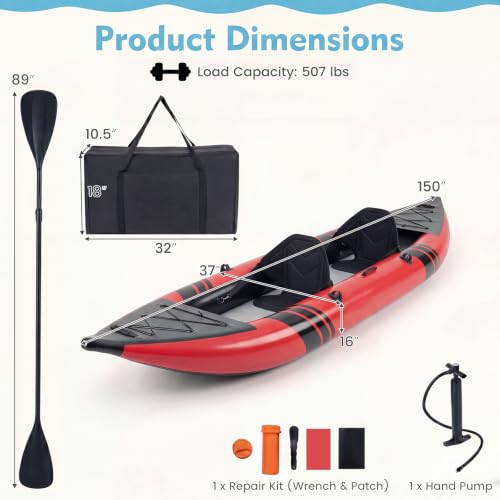
GYMAX Inflatable Kayak, 12.5Ft 507lbs Tandem Kayak with 2 Aluminum Paddles, 2 Padded Seats, Footrests, 2 Fins, Hand Pump, Carry Bag & Repair Kit, 2 Person Fishing Touring Kayak for Adults Youth (Red)


As an Amazon Associate we earn from qualifying purchases. Product prices and availability are accurate as of the date/time indicated.

Niphean Inflatable Kayak 2 Person, 12'6" Tandem Kayak with 500lb Capacity | 3-Chamber Stable Design, Drop-Stitch Floor, with Fishing Mounts, Camera Base, Kayaks Seats for Lakes, Touring, Fishing
As an Amazon Associate we earn from qualifying purchases. Product prices and availability are accurate as of the date/time indicated.
Prices shown are approximate and for reference only. Prices change often, so please check the current price on Amazon before you buy.
Specs and storage configurations summarize manufacturers’ published information for current versions; confirm bulkheads and hatch layout on the exact model year. Ratings are editorial, weighing loaded handling, storage system, comfort, safety features, and value for kayak camping.
The Six Camping Kayaks Reviewed
1. Wilderness Systems Pungo 120: Best Overall for Lakes and Slow Rivers
The Pungo is the boat most kayak campers actually start on, and its design confesses why: a huge, welcoming cockpit, a stability that lets a new paddler load dry bags without a dockhand’s anxiety, a rear hatch and bulkhead that swallow the weekend’s bulk, a dashboard that organizes the day’s small things, and the seat by which recreational seats are judged, adjustable in the places the fourth hour cares about. Its honest ceiling is its open bow and its recreational hull: it is a lake and slow river camper, not a sea boat, and its width trades the touring glide for its platform. Within that element, which is where most camping happens, it carries a weekend farther in comfort than boats costing half again as much, and its resale and rental ubiquity make it the easiest boat in this table to demo, to learn on, and eventually to pass to the next beginner at a fair price.
2. Old Town Loon 120: Best Value Rec-Touring Camper
The Loon answers the Pungo from one of paddling’s oldest names: a durable hull, a rear hatch system for the camp load, a work deck that keeps the day’s gear at hand, and a seat system built for the long sit, at a price a notch under the leader with Old Town’s dealer and warranty net beneath it. Its manners mirror its class, stable, friendly, happiest on sheltered water, and its build tolerates the beachings and boat ramp lessons of a first fleet’s seasons. For the camper whose water is the reservoir, the slow river, and the lake’s quiet arms, it is the value champion of the rec-touring pair, and the choice between it and the Pungo is properly made by sitting in both with a paddle in hand, because at this level the seat and the cockpit cast the deciding votes.
3. Dagger Stratos 12.5: Best for Mixed and Coastal Camping
The Stratos is the crossover that camps beyond the lake: two bulkheads and hatches for a real storage system, a skeg for the crossing’s crosswind, and a hull with genuine sea manners, edging, bracing, and riding chop with the composure its whitewater cousins taught it, in a length that still turns into a river’s eddy and fits a garage. It asks more of its paddler, its stability is the touring kind that rewards a brace, and it returns the skill with range: the coastal weekend, the big lake’s honest weather, the river trip with rapids between the camps. For the camper whose ambitions are already walking toward exposed water, it is the table’s growth stock, bought once and outgrown last, and its price buys the safety architecture, bulkheads, skeg, hull, that the rec boats honestly lack.
4. Perception Conduit 13.0: Best Budget True Touring
The Conduit is the budget camper’s door into the true touring class: thirteen feet of tracking hull, hatches and bulkheads at both ends in its class configuration, rudder-ready fittings for the paddler who wants one, and a major maker’s distribution and support, at the lowest price in this table. Its outfitting is its economy showing, a seat and braces a class plainer than the leaders’, which the aftermarket and a season’s tolerance answer, and its hull is a sound, honest touring shape that carries a load and holds a line. For the buyer who refuses to camp beyond a single bulkhead’s safety and cannot reach the Stratos or Tsunami’s prices, it is not a compromise to apologize for. It is the correct allocation, safety bought first and comfort upgraded later, which is the order this site always recommends.
5. Eddyline Skylark: Best Lightweight for Smaller Paddlers
The Skylark’s argument is weighed at the car roof: thermoform construction that takes pounds off the hull until loading it overhead alone stops being the trip’s crux, in a twelve foot touring hull with two bulkheads, a sea kayak’s safety in a package a smaller paddler can own entire, transport, launch, and load without a partner’s shoulders. Its glide flatters its length, its finish is the class’s jewelry, and its price is the thermoform premium in full. For the solo camper whose limiting factor was never the paddling but the logistics, it converts kayak camping from an expedition with a crew into a Tuesday decision, and that conversion is worth more than any single specification in this table to the paddler it describes.
6. Wilderness Systems Tsunami 145: Best for Long Trips and Big Water
The Tsunami 145 is the expedition end of the table: fourteen and a half feet of glide and tracking, two full hatches over two bulkheads with the volume for a week’s disciplined kit, configurations for the paddler’s steering preference, and a hull that has carried beginners across big lakes and kept experts honest company on coasts for generations of model years. Its size is its tax, on the roof, in the garage, and in the tight creek, and its cockpit fits the larger paddler best in this size. For the camper whose trips are growing in days and in water, it is the buy-once answer in plastic, the boat that removes the equipment question from the trip planning and leaves only the weather, which is where a touring camper’s attention belongs.
Buying Guide: How to Choose the Best Touring Kayak for Your Camping
Step One: Name Your Water and Your Longest Day
Sort yourself by the roughest water you will honestly camp on, not the calmest you hope for: sheltered lakes and slow rivers admit the rec-touring pair; mixed rivers, big lakes, and any coast require the bulkheads and hull of the Stratos, Conduit, Skylark, or Tsunami class, because flotation and seaworthiness are not upgrades but categories. Then name your longest day in miles, since length and glide are bought by the mile: under eight sheltered miles, the twelve foot boats serve; beyond that, or into wind, the thirteen and fourteen foot hulls repay their price in arrival times and remaining arms. Count capacity with your real weight plus fifty pounds of kit against the maker’s limit with a quarter to spare, and sit in every finalist with your paddling shoes on, because cockpit fit is the specification no chart can shop for you.
Step Two: Buy the Safety System With the Boat
Budget the boat as a system in the same purchase: a life jacket fitted for paddling and worn, always; a bilge pump and sponge; dry bags sized to the hatches you chose, bought after measuring them; float bags for any compartment without a bulkhead; a paddle that fits you, with a spare on the deck for trips beyond a swim from shore; and the roof system that carries the boat without drama, because a kayak that is hard to transport becomes a kayak that stays home, the most expensive outcome in camping. Price the used market in parallel, touring boats are durable and their used supply is deep, with the inspection this site teaches for all used hulls: bulkheads sealed, hatches sealing, hull free of deep gouges and oil-canning, outfitting intact. A used Tsunami-class boat at a Conduit price is the budget camper’s classic arbitrage, and it is found by the buyer who knows the classes cold.
Step Three: Earn the Range in Stages
Build the camping on a staircase: the loaded day paddle first, hatches packed as for a night, to learn the hull’s loaded manners in water you can stand in; then the single overnight close to the launch, where every packing mistake is a story rather than a situation; then the multi-night, with the float plan filed, the weather window chosen generously, and the turnaround rule agreed before the first stroke, because wind against a loaded boat halves a beginner’s speed and the plan must survive that arithmetic. Practice the wet exit and the self-rescue in warm, shallow water until they are boring, dress for immersion on every trip the water is cold, and let each season add one skill and one reach of water. The best touring kayak for camping is finally the one whose owner grew into it on that staircase, and every boat in this table will carry a camper who climbs honestly farther than a better boat carries one who leaps.
Frequently Asked Questions About Touring Kayaks for Camping
How much gear can a touring kayak actually carry for camping?
A weekend’s worth, packed with backpacking discipline, and the honest unit is weight and bulk together: most campers in this table’s boats carry thirty to fifty pounds, tent, sleep system, kitchen, food, and clothing in dry bags, with water as the swing item, a gallon weighing over eight pounds and best carried centered and low or planned around sources and a filter where the route allows. Volume is the subtler limit: hatches swallow soft, divisible loads gracefully and rigid, bulky items not at all, so the kayak camper’s kit converges on the backpacker’s, compressible insulation, a tent that splits between two hatches or two boats, food repacked out of its store packaging. Weigh your loaded boat once on a bathroom scale’s two trips, you and then you holding the bags, and compare it to the maker’s capacity with the margin this guide insists on, because an overloaded touring kayak is not merely slow. It is a different and worse boat, low, sluggish, and shy of freeboard in the chop it must cross.
Do I need a spray skirt for kayak camping?
On sheltered water in kind weather, the rec-touring camper can fairly treat it as optional; on any water where waves, wakes, or weather can board the cockpit, and on every trip in the sea-capable boats, it is equipment, because a cockpit that takes a wave’s bucket with every crest is a bilge pump workout and, loaded, a stability problem. The skirt’s condition is training: a paddler must be able to release it blind, by its loop, upside down, without a thought, which is a warm shallow water skill of one afternoon, and a skirt worn without that skill is a hazard wearing safety’s clothing. Buy the skirt sized to your cockpit’s rim, neoprene for the cold and the rough, nylon for the mild and the budget, practice until the exit is boring, and the question answers itself by water rather than by dogma, which is how this guide prefers every safety question answered.
Skeg or rudder: which is better for a camping kayak?
This guide prefers the skeg for camping, for reasons of the beach rather than of the brochure: a skeg is a small fin that drops from a slot in the hull’s stern, with nothing above deck to break on a rocky landing, no cables to snag the deck bag, and a trimming action, a little down for a crosswind, up for the shallows, that teaches the paddler to balance the hull rather than to steer around its habits. A rudder steers actively with the feet and serves some paddlers well, photographers and anglers whose hands are busy, and sailors of very long boats in following seas, at the cost of moving parts living exactly where camping gear is dragged and dropped. Either system beats the third option, the fixed nothing of the rec boats, once the water opens and the wind stands up, so choose by your water: sheltered, neither is needed; exposed, take the skeg’s simplicity and spend the savings on the pump, the bags, and the lessons.
Can a beginner start kayak camping in a touring kayak?
Yes, and the touring kayak is in several ways the kinder teacher, provided the beginner climbs this guide’s staircase instead of leaping to the expedition. The touring hull’s glide rewards a correct stroke immediately, its bulkheads forgive the first capsize with a boat that floats level for the rescue, and its comfort extends the learning day. Its tenderness at the dock is the tuition: an hour of bracing and edging practice in shallow water converts it from a worry into a skill the rec boat never teaches. Choose the wider, friendlier end of the class, the Pungo and Loon’s stability with the Stratos as the second season’s horizon for most, take a basics class if one exists within driving distance, because a single day of instruction compresses a season of self-teaching, and start with the loaded day paddle and the near overnight. Beginners become kayak campers one honest stage at a time, and the ones who start that way are, in this guide’s observation, the ones still doing it in the tenth season.
Related guides
- Best Portable Camping Battery Pack in 2026: How to Pick a Portable Camping Battery Pack That Powers Your Phone, Lights, and Camping Gear All Trip
- Best Touring Kayak for Camping in 2026: Best Touring Kayak for Camping
- Best Camping Battery Pack in 2026: 6 Power Banks With at Least 10,000mAh, USB-C Power Delivery, and a Price Range, for Camping
- Best Tandem Kayak for Camping in 2026: How to Pick a Tandem Kayak That Fits Two Campers, Carries Your Camping Gear, and Works for Your Camping Trip
More from Amazon
Programs that pair well with the guide above. Offers and eligibility are set by Amazon and may change.
Free shipping on eligible items, Prime Video and more. Eligible new members can start with a free trial.
Start a Prime free trialA Prime membership for ages 18-24 with a trial period. Eligibility is set by Amazon.
See Prime for Young AdultsAudiobooks and podcasts to listen to on the go. Eligible new members can start with a free trial.
Try Audible freeAd-free music streaming. Eligible new subscribers can start with a free trial.
Try Music Unlimited freeAs an Amazon Associate we earn from qualifying purchases.

Write Your Review
No reviews yet. Be the first to share your experience!