
What's inside
- Best Sleeping Bag Stuff Sack Durability Guide: What Actually Breaks and Why
- Best Sleeping Bag Stuff Sack Durability Guide: Quick Comparison
- The Six Sacks Reviewed for Durability
- Buying Guide: How to Choose a Sleeping Bag Sack That Lasts
- Frequently Asked Questions About Sleeping Bag Stuff Sack Durability
As an Amazon Associate I earn from qualifying purchases. This post may contain affiliate links at no extra cost to you.
A best sleeping bag stuff sack durability guide exists because the stuff sack is the hardest-worked, least-respected component in the sleep system. It is cranked down with a camper’s full enthusiasm, kneeling on the bag, hauling the straps until the sack is a rigid brick; it is dragged across tent floors and gravel, stuffed against stove edges and bear canister rims, sat on as a camp pillow, and left compressed in a hot trunk between trips, and it is expected to do all of this in a fabric thinner than a shirt. Most sacks die young and predictably: a strap tears out at its stitching, a buckle snaps in the cold, a seam lets go along the compression line, or the coating peels until the water resistance is a memory. This guide compares six real, currently sold sleeping bag sacks, compression and dry sack designs, graded on durability as the first virtue, explains the construction details that predict a sack’s lifespan, the fabric deniers, the strap attachments, the buckle quality, the seam work, and teaches the use habits that double any sack’s life, because the best sleeping bag stuff sack is the one whose owner stops trying to kill it, and the second best is the one built to survive owners who do not stop.
Frame the purchase correctly before the table. A sleeping bag sack does up to three jobs: it compresses the bag to a packable volume, it protects the bag from the pack’s abrasion and the trip’s weather, and, in the dry sack designs, it is a waterproof insurance policy for the one item in the pack that must never get wet, since a soaked bag on a cold night is a safety problem wearing a packing problem’s clothes. The durability question touches all three jobs, because a failed sack fails them simultaneously, mid-trip, at the moment the compression was most needed. It is also a small purchase with an outsized consequence, which is why this budget site grades it seriously: a twenty to forty dollar sack protects a two hundred dollar bag and the night’s sleep inside it, and the camper who buys the sack by its durability rather than by its color is practicing the exact economics this site exists to teach.
Our Top Picks
Best Sleeping Bag Stuff Sack Durability Guide: What Actually Breaks and Why
Fabric: Denier, Weave, and the Coating’s Slow Goodbye
A sack’s fabric is graded first by denier, the yarn’s weight, which in this category runs from the ultralight 10 to 30 denier nylons up through 70 and beyond in the workhorse designs, and the trade is written plainly: every step down in denier saves grams and spends abrasion life. The ripstop weave, the grid of heavier threads woven through the face, is the ultralight’s saving grace, containing a puncture to one cell of the grid instead of a run the length of the sack, and any sack under 30 denier without ripstop should be read as disposable. Coatings decide the water story and its lifespan: silicone impregnated fabrics, silnylon, wear their water resistance in the fabric itself and age gracefully; polyurethane coatings sprayed on a face shed water well when new and peel or turn tacky across hot seasons of storage, the familiar sticky sack of the third summer. The durability champion’s construction, visible in this table’s leaders, pairs a moderate denier ripstop with a treatment that is part of the cloth rather than a paint on it, and the buyer’s test in the shop is tactile: the fabric should feel like cloth, not like a shower curtain, because shower curtains are what failing coatings feel like a season before they fail.
Straps, Stitching, and Buckles: The Three Autopsy Findings
Compression sacks almost never die of their fabric; they die of their attachments, and the autopsy findings are three. First, the strap anchor: the webbing that takes the full cranking load is either stitched in a reinforced box and cross pattern into a reinforced panel, the construction that survives, or bar-tacked once to single fabric, the construction that tears out, usually on a cold morning at maximum compression. Inspect it before buying and grade it without mercy, because it is carrying your body weight’s worth of enthusiasm. Second, the seams: the sack’s body seams live under the compression’s hoop stress, and double stitching or taped and rolled seams in the dry designs are the difference between a seam that serves a decade and one that unzips along the line. Third, the buckles: the small plastic side-release and ladderlock buckles that tension the straps are the sack’s cold-weather weak point, snapping at the temperatures where bags are most compressed, and the better makers use quality hardware from the established buckle houses, a detail invisible in photographs and decisive in January. The reviews below grade all three findings per sack, because a durability guide that talks about fabric and skips the anchors is reviewing the part that does not break.
Compression vs Dry Sack: Two Philosophies of Protection
The category divides by philosophy, and the durable choice depends on your weather. The compression sack, straps and a drawstring or lid, exists to make the bag small; its water resistance is a coating’s courtesy, fine against the pack’s damp and a brief drizzle, not a submersion or a day of rain against a pack cover’s failure. The compression dry sack adds a roll-top waterproof closure and sealed seams, and in its best form, the eVent designs in this table, a breathable waterproof base that lets air escape as you compress, so the sack squeezes down without fighting its own trapped air and seals the bag against the river crossing and the storm day alike. The dry design costs more, weighs a little more, and carries the failure modes of its seals, which the owner maintains by keeping grit out of the roll. For the camper whose trips are dry and whose pack is organized, the plain compression sack’s simplicity is its durability. For the canoeist, the coastal hiker, and anyone whose bag is their survival margin, the dry sack’s insurance is the durability that matters, measured in nights rather than in seasons, and this guide grades each design inside its own philosophy.
Best Sleeping Bag Stuff Sack Durability Guide: Quick Comparison
| Sleeping Bag Sack Model | Key Specs | Best For | Typical Price Range | Rating |
|---|---|---|---|---|
| Sea to Summit eVent Compression Dry Sack | Roll-top dry closure, eVent breathable base in class, sealed seams class, rugged nylon body, multiple sizes | Best sleeping bag stuff sack overall for durability and weather | $35 – $55 by size | 4.7 / 5 |
| Granite Gear Compression DrySack (eVent Sil) | eVent and silnylon construction in class, roll-top, block-shaped packing class, long-standing design | Best for backpacking durability per weight | $30 – $45 | 4.5 / 5 |
| Sea to Summit Ultra-Sil Compression Sack | Siliconized ripstop in class, compression straps, reinforced anchors in class, very light | Best ultralight compression durability | $25 – $40 | 4.4 / 5 |
| REI Co-op Compression Stuff Sack | Heavier denier body in class, four-strap compression, drawcord top, house-brand warranty support | Best workhorse value | $20 – $30 | 4.4 / 5 |
| Outdoor Research Helium Compression Sack | Lightweight ripstop in class, compression straps, OR build and warranty heritage | Best light sack from a mountaineering maker | $30 – $45 | 4.3 / 5 |
| ALPS Mountaineering Compression Sack | Budget compression design, heavier fabric class, multiple sizes, simple construction | Best budget durability | $12 – $22 | 4.1 / 5 |

NUXSQUAR Stuff Sack For Sleeping Bag & Camping gear, Blue, 8L | Choose from 8L, 40L, 65L, and 100L sizes for hiking, camping, travel, and everyday gear storage.


As an Amazon Associate we earn from qualifying purchases. Product prices and availability are accurate as of the date/time indicated.
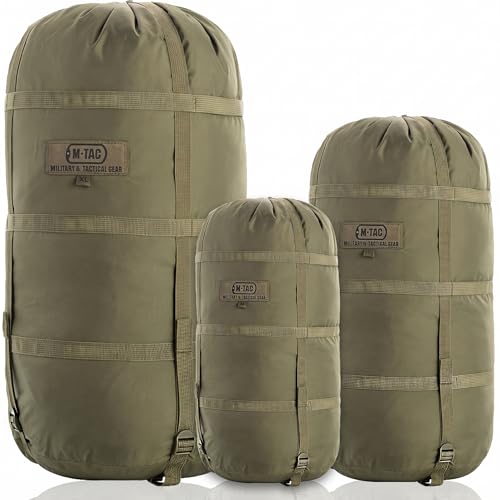
M-Tac Compression Stuff Sack for Sleeping Bag Military Water Resistant Compression Bag Lightweight Nylon Compression Sack for Travel, Camping, Hiking, Outdoor (Olive, L - 24 Liters)
As an Amazon Associate we earn from qualifying purchases. Product prices and availability are accurate as of the date/time indicated.

Frelaxy Compression Sack, Ultralight Sleeping Bag Stuff Sack Compression Stuff Sack - Space Saving Gear for Camping, Hiking, Backpacking (Turquoise, S)
As an Amazon Associate we earn from qualifying purchases. Product prices and availability are accurate as of the date/time indicated.
Prices shown are approximate and for reference only. Prices change often, so please check the current price on Amazon before you buy.
Sizes and constructions summarize manufacturers’ published information for current versions; match the sack’s liters to your bag’s compressed volume. Ratings are editorial, weighing anchor and seam construction, fabric and coating longevity, buckle quality, weather protection, and value.
The Six Sacks Reviewed for Durability
1. Sea to Summit eVent Compression Dry Sack: Best Overall
This sack is the category’s engineering answer to its own autopsy report. The roll-top closure seals like a dry bag because it is one; the seams are sealed; the base is eVent, a waterproof breathable fabric that lets the trapped air bleed out as the straps come down, so the compression load is borne by the design rather than fought against it; and the body fabric and strap anchors are built to the standard of a company whose dry bags cross oceans. It compresses a bag to a dense, waterproof brick that can ride outside the pack, in a canoe’s bilge, or under a pack cover’s failure without the night’s sleep ever being consulted. Its price is the table’s top and its ritual is the roll-top’s, three clean rolls with grit kept out of the seal. Judged on durability in both senses, the seasons it survives and the night it saves, it leads this table without a close argument.
2. Granite Gear Compression DrySack: Best Backpacking Durability per Weight
Granite Gear’s design is the thru-hiker’s institution: silnylon married to an eVent base, a roll-top seal, and a slightly blocky shaping that packs a backpack’s bottom compartment the way a brick fills a wall, without the dead corners a cylinder leaves. Its durability story is the silnylon’s, water resistance in the fabric rather than on it, aging without peeling, in a weight class the distance hiker accepts. Its straps and anchors have survived the trail’s longest audits, thousands of miles of daily cranking by owners who own one sack and use it without sentiment. For the backpacker whose bag must stay dry through a season of weather in a sack that weighs almost nothing, it is the connoisseur’s row, and its years in production are themselves a durability statistic.
3. Sea to Summit Ultra-Sil Compression Sack: Best Ultralight Compression
The Ultra-Sil strips the dry closure away and keeps the engineering: siliconized ripstop, compression straps anchored to the standard its maker’s reputation requires, and hardware that survives the cold, in a sack light enough for the gram counter’s spreadsheet. Its water resistance is the coating’s honest level, weather courtesy rather than submersion insurance, and its durability is the fabric and anchor story told well at minimum weight. It is the sack for the dry-climate backpacker and the organized pack whose liner already carries the waterproofing duty, letting this sack specialize in compression. Sea to Summit’s presence twice in this table’s lead is not favoritism; it is what a category looks like when one maker treats a humble component as engineering, and the Ultra-Sil is the proof at the light end.
4. REI Co-op Compression Stuff Sack: Best Workhorse Value
REI’s house sack is the durability of honest weight: a heavier denier body than the ultralight rows, four compression straps spreading the load, a drawcord top under a lid, and construction that favors the car camper and the scout troop, the users who treat gear communally and lose the delicate stuff. It weighs what it weighs and apologizes by surviving, and the Co-op’s satisfaction guarantee stands behind it in a way that converts durability from a property into a promise. Its water resistance is the courtesy class and its packed shape is the classic cylinder. For the family gear closet, the loaner fleet, and the beginner whose technique is still developing at the straps’ expense, it is the table’s most forgiving purchase, and forgiveness, in a component this abused, is a durability feature.
5. Outdoor Research Helium Compression Sack: Best From a Mountaineering Maker
The Helium brings a mountaineering house’s standards to the light compression class: ripstop fabric, tidy strap work, and hardware chosen by people whose other products are trusted at altitude, backed by a warranty culture that has historically treated its owners generously. Its design is the straightforward compression pattern executed cleanly, no dry seal, no breathable base, and its durability is the competence kind, nothing exotic to fail and nothing flimsy to forgive. It costs more than the REI workhorse and weighs less, the classic exchange, and for the camper whose kit is already OR-flavored and whose trips are fair weather backpacking, it is the coherent choice. It earns its row on execution, the virtue that durability guides exist to reward.
6. ALPS Mountaineering Compression Sack: Best Budget Durability
ALPS builds the sack the budget camper’s closet actually contains: simple, heavier-fabric compression in a run of sizes, at a price that makes buying two, one per bag in the family fleet, a rounding error. Its construction is the honest budget kind, anchors and seams adequate to the loads its straps can generate, hardware that serves in the temperate seasons its buyers mostly camp, and no waterproof pretensions beyond a coating’s courtesy. Its durability per dollar is the table’s best even as its absolute durability trails the leaders, which is the correct budget arithmetic: a sack that survives four seasons at a third of the leader’s price has beaten the leader at the budget game’s own scoring. Replace it without grief when its seams announce their retirement, and know that the announcement, at this price, is a fair trade honestly made.
Buying Guide: How to Choose a Sleeping Bag Sack That Lasts
Step One: Size It to the Bag, Then Inspect the Anchors
Match the sack’s volume to your bag’s compressed size, not its shelf size: a winter bag wants the large sacks, a summer quilt the small, and a sack too large wastes the compression while a sack too small transfers your cranking enthusiasm directly to the seams, the leading cause of the anchor failures in this guide’s autopsy. Use the bag maker’s stated compressed volume or the sack maker’s bag-size chart, and when between sizes, take the larger and let the straps do honest work. Then inspect, in the shop or on arrival, the three findings: strap anchors stitched in reinforced patterns into reinforced panels; body seams double stitched, taped, or rolled to a standard your thumbnail respects; buckles that click with a quality snap and carry a known hardware maker’s confidence. A sack that passes those three inspections in a fabric of 30 denier ripstop or better will outlive two that were bought on color and capacity alone.
Step Two: Choose the Philosophy by Your Wettest Trip
Let the worst weather you actually camp in choose between the compression and the dry designs. Fair weather and a pack liner already in your system: the plain compression sack, simpler and lighter, with the liner carrying the waterproofing. Rain country, canoe and kayak trips, coastal weather, or a down bag whose wet failure would end the trip or worse: the compression dry sack, whose sealed seams and roll-top are the bag’s insurance policy, with the eVent base earning its premium every time you compress without wrestling the trapped air. Down bags argue one step drier than synthetics in this decision, since down’s loft, once soaked, is the night’s whole warmth gone, while a synthetic bag forgives a damp sack with a clammy night rather than a dangerous one. Price the insurance honestly: the dry leaders cost a dinner out more than the plain sacks, amortized across the decade they serve and the one night they save, which is the cheapest arithmetic in this entire guide.
Step Three: Use It Like You Want to Keep It
Technique is half of durability, and the rules are few and absolute. Stuff the bag, never roll or fold it into the sack, because stuffing distributes the wear and the loft’s stress randomly, as every bag maker instructs. Compress progressively, walking the straps down a little at a time around the sack rather than hauling one strap to its limit, which is the anchor tear’s exact mechanism. Keep the sack’s contents innocent: no stove, no stakes, no cramponed anything sharing the bag’s compartment, and keep grit out of a dry sack’s roll with a shake and a wipe before sealing. At home, release the compression entirely and store the bag loose or in a large cotton storage sack, because a bag stored compressed loses loft and a sack stored cranked ages its straps and seams for nothing, the double waste this site has preached against in every sleep system article it has published. Wash the sack rarely, gently, and dry it fully before storage, and inspect it each season, anchors, seams, buckles, coating, retiring it at the first structural announcement rather than mid-trip at the second. A sack used this way from this table’s top half is a decade’s companion; used carelessly, the same sack is a season’s, and the difference was never the sack.
Frequently Asked Questions About Sleeping Bag Stuff Sack Durability
How long should a good compression sack last?
A well-made sack from this table’s upper half, used with the technique in this guide, should serve five to ten seasons of regular camping, its retirement announced by a fraying anchor stitch, a seam’s slow opening, a buckle’s crack, or a coating’s peel, in roughly that order of likelihood. The ultralight sacks trade some of that span for their grams, three to five hard seasons being an honorable service, and the budget workhorses land between, their heavier fabrics lasting and their hardware retiring first. The variables that move any sack between the short and long ends of its range are yours: progressive compression rather than the single haul, loose storage rather than the permanent crank, and a pack interior free of sharp roommates. Judge a sack’s death fairly when it comes; a component that absorbed a decade of your full enthusiasm for the price of a pizza has not failed you, it has completed one of camping’s better bargains, and its replacement, bought by this guide’s inspections, starts the next decade.
Is a compression dry sack worth it over a regular stuff sack?
For the camper whose bag is down, whose trips include real rain, open boats, or river crossings, or whose pack has no liner system, yes, decisively: the dry sack is the difference between a wet trip and a wet trip with a dry bed, and a sleeping bag is the one load in the pack whose dryness is a safety property rather than a comfort preference. The eVent base models earn their specific premium by ending the fight against trapped air, the daily annoyance that makes plain dry sacks get left unsealed and therefore un-dry. For the fair weather car camper whose bag travels in a vehicle and a tent, the honest answer is no: a plain compression sack and the trunk’s dryness do the same job, and the savings buy the storage sack the bag should live in at home. Match the insurance to the exposure, which is this guide’s rule for the whole category, and neither buyer has overpaid.
Can I repair a torn strap anchor or seam myself?
The seam, often yes; the anchor, carefully and with lowered expectations. A body seam that has opened along its stitch line can be re-sewn with a heavy needle and bonded nylon or polyester thread, following the original line and extending an inch past the damage at both ends, and a dab of seam sealer over the repair restores much of the weather story; this is a fair home repair that returns a sack to seasons of service. A torn strap anchor is a structural failure at the sack’s highest load point, and a home stitch through weakened fabric is a repair that will choose its own moment to re-fail, at full compression, possibly at a trailhead far from options; the honest options are a gear repair shop’s reinforced patch, the maker’s warranty, since several makers in this table stand behind their construction generously, or retirement. The field expedient, a safety pin or a wrap of repair tape, is a get-home measure, and the get-home is where its duty ends. Sew the seams, warrant the anchors, and inspect both each season so the decision is made at home, where it belongs.
Should I store my sleeping bag in its compression sack between trips?
No, and this guide ends on the rule because it is the most violated and the most consequential in the sleep system’s whole care. A bag stored compressed, down above all, slowly loses the loft that is its warmth, as the fill’s fibers and clusters take a set under the constant load, and while a trip’s week of compression is harmless and a season’s storage is a measurable theft of degrees, the habit is the difference between a bag that serves a decade at its rating and one that mysteriously sleeps colder in its third year. Store the bag loose, in the large cotton or mesh storage sack most makers include, or hung, or laid in a dry closet’s generous corner, and let the compression sack live empty with the camping gear, its straps slack and its fabric dry. The rule costs a closet’s corner and returns a bag’s rated life, and it applies to the sack itself, whose straps and seams age under a stored crank for exactly nothing. Compress for the trail, never for the shelf, and both halves of the sleep system will be serving when the camper who stored them cranked is shopping for replacements and wondering why.
Related guides
- Best Portable Camping Battery Pack in 2026: How to Pick a Portable Camping Battery Pack That Powers Your Phone, Lights, and Camping Gear All Trip
- Best Touring Kayak for Camping in 2026: Best Touring Kayak for Camping
- Best Camping Battery Pack in 2026: 6 Power Banks With at Least 10,000mAh, USB-C Power Delivery, and a Price Range, for Camping
- Best Tandem Kayak for Camping in 2026: How to Pick a Tandem Kayak That Fits Two Campers, Carries Your Camping Gear, and Works for Your Camping Trip
More from Amazon
Programs that pair well with the guide above. Offers and eligibility are set by Amazon and may change.
Free shipping on eligible items, Prime Video and more. Eligible new members can start with a free trial.
Start a Prime free trialA Prime membership for ages 18-24 with a trial period. Eligibility is set by Amazon.
See Prime for Young AdultsAudiobooks and podcasts to listen to on the go. Eligible new members can start with a free trial.
Try Audible freeAd-free music streaming. Eligible new subscribers can start with a free trial.
Try Music Unlimited freeAs an Amazon Associate we earn from qualifying purchases.

Write Your Review
No reviews yet. Be the first to share your experience!