
What's inside
As an Amazon Associate I earn from qualifying purchases. This post may contain affiliate links at no extra cost to you.
The best suv for camping and kayaking is the vehicle that does the two jobs’ shared work without drama: it carries a kayak on its roof at highway speed without the driver white-knuckling the wheel, swallows a family’s camping cargo without a packing argument, reaches the campsite and the put-in down the forest roads and boat ramps where these trips actually end, and does all of it at a price and a fuel bill a budget camper can sustain for a decade of weekends. That specification sounds ordinary and eliminates most of the market, because the modern crossover herd divides sharply on exactly these virtues: roof rail systems that accept real crossbars against decorative rails that accept nothing, dynamic roof load ratings that admit two kayaks against sunroof-era limits that admit one light boat, cargo floors that fold flat enough to sleep on against sculpted wells that fit nothing rectangular, and all-wheel drive systems with genuine rough-road composure against systems that exist for the brochure’s snow photograph. This guide compares six real, currently sold SUVs graded for the camping-and-kayaking brief on a budget: roof and rack readiness, cargo and sleep-flat utility, ground clearance and traction for ramps and forest roads, towing headroom for the small trailer some households graduate to, and total cost of ownership, the budget camper’s true specification.
Read the requirements into numbers before the table. The kayak’s demand is the roof’s: two recreational boats commonly weigh 80 to 110 pounds together, plus the rack and carriers, against a dynamic roof rating, the limit while moving, that must clear the total with margin, and the rating is a maker’s figure to be verified for the exact trim, since a panoramic roof can halve it on the same model. The camping demand is the cargo hold’s: a family’s tent, bags, cooler, stove, and chairs measure out to a volume that the seats-down figures advertise and the seats-up figures confess, and the floor’s flatness decides whether the SUV doubles as the emergency motel, a role this readership values more than any other in the category. The road’s demand is clearance and traction honestly matched to the mission, gravel, sand at the ramp’s edge, the wet grass field that serves as the festival parking, rather than rock-crawling theater the budget should not pay for. And the decade’s demand is the ledger: purchase price in the friendly half of the market or the used market’s sweet spot, fuel economy that keeps the far lake in range, and reliability that does not convert the savings into a transmission. The table is graded on those four, and the buying guide ends where budget campers actually buy, in the used listings as much as the showroom.
Our Top Picks
Best SUV for Camping and Kayaking: Roof Loads, Flat Floors, and Real-World Clearance
The Roof: Rails, Crossbars, and Two Kayaks at Highway Speed
Grade the roof as a system with three links, any of which ends the conversation. The rails or mounting points come first: raised rails accept universal crossbars and the whole aftermarket’s carriers; flush rails and fixed points accept maker and quality aftermarket feet at higher cost; and the bare roof, clip-fitted or barefoot, serves a single light boat and a nervous driver, which for a kayaking household is a disqualification wearing a discount. The dynamic load rating comes second, verified for the exact trim from the maker’s own documents, remembering that the figure must carry boats plus rack plus carriers, and that the static rating, the parked limit that rooftop tents cite, is a different and larger number that must never be borrowed for the highway. The loading itself is the third link, a human one: a tall SUV and a heavy kayak are a shoulder injury’s recipe, and the household’s honest strength should elect between the lower rooflines of the wagon parish, the Outback above all, the assisted carriers that winch and lift, and the trailer that ends the argument for the multi-boat family. Buy the roof as you will use it in the rain at the take-out in October, not as it gleams in the listing.
Cargo, Sleep-Flat Floors, and the Emergency Motel
The camping SUV’s second office is its hold. Seats-down volume is the headline, but the floor’s biography matters more: the step between the folded seat and the cargo deck that turns a sleeping pad into a lumbar argument, the wheel-well intrusions that refuse the cooler its corner, the underfloor well that either swallows the stove and the recovery gear or hoards a spare tire the household may prefer to keep. The leaders of this table fold genuinely flat or near enough that a platform of two storage bins and a board, the budget camper’s classic, levels the parish perfectly. Length is the sleeper’s figure, six feet of flat floor being the difference between sleeping and negotiating, and the front seats’ forward travel is part of that measurement. Around the hold, the small furniture accumulates value across a decade: tie-downs that exist, a 12-volt outlet in the cargo area for the fridge, a tailgate that shelters the camp kitchen in the rain, and a rear window or hatch arrangement that ventilates the sleeping configuration without inviting the mosquito congregation in, the screen-and-fan details the experienced car camper assembles in the first season.
Clearance, AWD, and the Boat Ramp’s Honest Tests
Match the running gear to the terrain these trips actually contain, which is humbler and slipperier than the advertisements’. The tests are the wet boat ramp, algae at the waterline and a trailer or a roof’s worth of weight asking the front wheels for grip; the sand and mud of the unimproved put-in; the forest road’s washboard and its one washed-out culvert; and the snow of the shoulder seasons at the mountain lake. Against those, the equipment that matters is all-wheel drive that engages before the slip becomes a scene, ground clearance in the eight-inch class and above for the culvert and the ramp’s breakover, tires with sidewalls and tread for gravel rather than the low-profile pavement jewelry of the style trims, and, where offered, the drive modes and hill descent courtesies of the outdoors trims. The locking differentials and low ranges of the true 4×4 parish serve a harder country than this brief, and the budget camper pays for them in fuel every ordinary day; the table’s grades therefore reward the honest middle, enough for every ramp and forest road in the state park system, and name the one row that goes further for the household whose water is genuinely remote.
Best SUV for Camping and Kayaking: Quick Comparison
| SUV Model | Key Specs | Best For | Typical Price Range | Rating |
|---|---|---|---|---|
| Subaru Outback | Standard AWD in line, raised rails with integrated crossbars class, ~8.7in clearance class, wagon roofline | Best suv for camping and kayaking overall | $30,000 – $42,000 new by trim | 4.8 / 5 |
| Toyota RAV4 (incl. Woodland class) | AWD available in line, strong cargo class, outdoors trims in line, hybrid economy class | Best all-round and hybrid value | $30,000 – $43,000 new by trim | 4.6 / 5 |
| Subaru Forester | Standard AWD in line, tall cargo class, ~8.7in clearance class, raised rails | Best visibility and easy loading | $30,000 – $40,000 new by trim | 4.6 / 5 |
| Ford Bronco Sport | Standard 4WD in line, safari roof cargo class, outdoors design positioning | Best small SUV for rough put-ins | $31,000 – $42,000 new by trim | 4.4 / 5 |
| Honda CR-V | AWD available in line, large cargo class, hybrid options in line, refined road manners | Best family-first compromise | $31,000 – $42,000 new by trim | 4.4 / 5 |
| Toyota 4Runner | Body-on-frame 4WD in line, high clearance class, large roof capacity parish, lower economy | Best for remote water and towing | $43,000 – $58,000 new by trim | 4.3 / 5 |

WildFinder SUV Tent, Universal Car Tents for Camping, SUV Tailgate Tent | 10x9ft Large, PU3000 Waterproof, Camping Tent Universal Compatible with SUV, CUV, Easy Setup Standalone Shelter for Outdoor
As an Amazon Associate we earn from qualifying purchases. Product prices and availability are accurate as of the date/time indicated.

KingCamp SUV Tent, Instant 6-8 Person Waterproof & Windproof Tailgate Car Camping Tent with Movie Screen for Family Camping & Outdoor Adventures
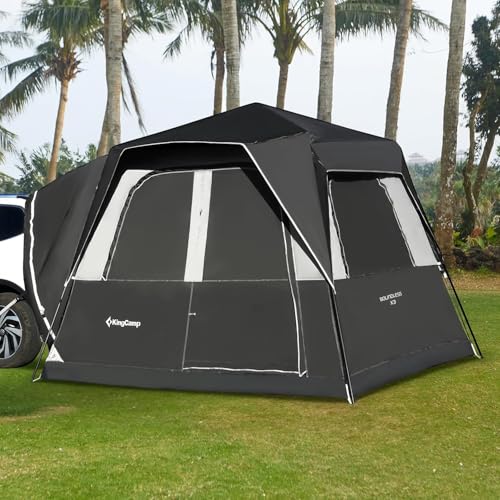


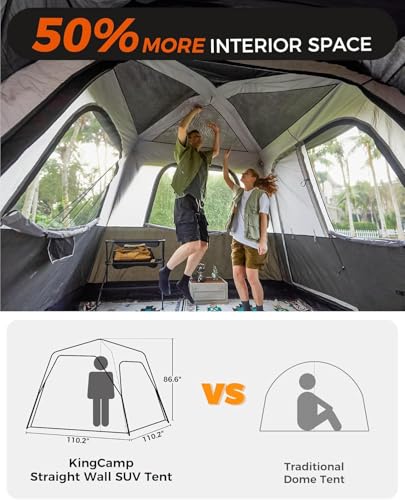

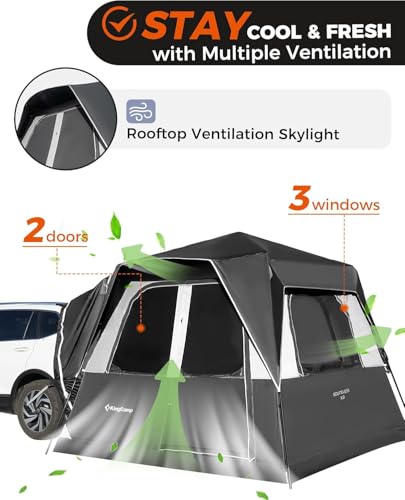


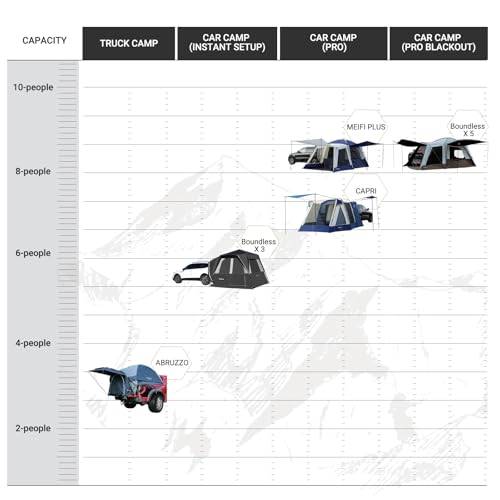
As an Amazon Associate we earn from qualifying purchases. Product prices and availability are accurate as of the date/time indicated.

TIMBER RIDGE 5 Person Truck-Bed-Tents SUV Camping Tent | Car Camping Weather Resistant Storage Bag 10' W X 8' L X 7.1' H Portable
As an Amazon Associate we earn from qualifying purchases. Product prices and availability are accurate as of the date/time indicated.
Prices shown are approximate and for reference only. Prices change often, so please check the current price on Amazon before you buy.
Roof load ratings, clearances, and cargo figures refer to the makers’ published specifications for the exact trim; verify before purchase, especially dynamic roof limits with panoramic roofs. Prices are typical US ranges for new vehicles by trim; used examples commonly sell well below these ranges. Ratings are editorial for budget camping and kayaking, weighing roof readiness, cargo and sleep utility, rough-road ability, economy, and value.
The Six Camping and Kayaking SUVs Reviewed
1. Subaru Outback: Best Overall
The Outback leads on the brief’s whole syllabus: standard all-wheel drive, the lowest and easiest kayak loading height in the parish, raised rails whose integrated crossbars swing out of the stowed position in a minute, clearance that handles the forest road, and a wagon’s long flat floor that sleeps two without architecture. Its CVT and its styling divide opinion and neither matters at the put-in. For the camping-kayaking household buying once, it is the recommendation defended first, new or used.
2. Toyota RAV4: Best All-Round Value
The RAV4 answers with Toyota’s reliability ledger, a hybrid line whose fuel economy stretches the trip radius, outdoors trims that add the clearance and tires of the brief, and a cargo hold near the class summit. Its rails and roof ratings ask the trim-level verification of the text. As the default shortlist’s other name, it has carried more boats than any vehicle in this table.
3. Subaru Forester: Best Visibility and Loading
The Forester’s tall glass and upright hold serve the driver who maneuvers a loaded vehicle on a ramp by eyesight rather than by camera, with the same Subaru AWD and rails doctrine as its sibling and a boxy cargo space that swallows the camp’s rectangles. Its roof is taller to load than the Outback’s, the one honest trade. For the visibility-first buyer, it is the parish’s answer.
4. Ford Bronco Sport: Best Small and Rough
The Bronco Sport packs genuine rough-road equipment, standard 4WD, terrain modes, a safari-style roof with real cargo intent, into the table’s smallest footprint and friendliest parking manners. Its cargo volume is the compact class’s confession. For the solo and duo camper whose put-ins are the roughest in the county, it is the spirited choice.
5. Honda CR-V: Best Family Compromise
The CR-V brings the class’s most refined road manners and a cavernous hold to the brief, with hybrid economy and Honda’s reliability, asking the buyer to verify the roof parish carefully since its rails vary by trim. On pavement between the lakes it is the table’s most pleasant citizen. For the family whose camping shares a vehicle with the school run, it is the diplomacy that works.
6. Toyota 4Runner: Best for Remote Water
The 4Runner is the table’s expedition row: body-on-frame strength, serious clearance and 4WD, towing headroom for the boat trailer, and a roof that shrugs at loads, paid for in fuel and in a purchase price above the budget parish’s heartland. Its used market is the budget door into it. For the household whose water is an hour past the pavement, nothing else here substitutes.
Buying Guide: How to Choose an SUV for Camping and Kayaking
Step One: Verify the Roof and the Floor on the Exact Trim
Shop the trim, not the model: on the maker’s own documents for the exact vehicle, confirm the dynamic roof load rating, the rail type, the seats-down cargo length and the floor’s flatness with your own tape at the dealership, a kayak’s weight and your family’s cargo list written beside the figures. Test the loading with the dealer’s blessing or a friend’s identical vehicle, since the shoulder’s verdict on a tall roof is a decade-long fact. Strike any trim whose panoramic roof quietly halves the rating your two boats require, and let no salesperson’s assurance substitute for the printed figure, because the roof is the one specification this entire purchase stands on, literally, at seventy miles an hour.
Step Two: Buy the Decade, New or Used, With the Ledger Open
Run the ownership arithmetic across ten years rather than the payment across five: fuel at your real trip mileage, tires in the size the trim wears, the outdoors trims’ premium against the accessories you would otherwise buy, and the used market’s sweet spots, the three-to-five-year-old Outbacks and RAV4s whose depreciation is the budget camper’s oldest subsidy. On a used candidate, inspect for the brief’s biography: roof rail wear and a cargo hold’s scars tell the truth about a previous camping life, which is a good sign in moderation, and the service records of the AWD system and transmission are the papers that matter. Budget in this step for the rack itself, quality crossbars where they are not integrated and the kayak carriers, since a vehicle bought to the last dollar with nothing left for its roof is a kayak system missing its middle.
Step Three: Fit the System and Take the Shakedown Trip
Complete the vehicle as a system before the first real trip: the rack installed and torqued, the boats loaded and strapped with bow and stern lines as the highway requires, the cargo Tetris rehearsed in the driveway until the camp loads in twenty minutes without a raised voice, and the sleep configuration tested for one backyard night with the screens and the fan of the text. Then take the shakedown, a near lake, an easy ramp, a single night, and let it expose the loading height’s truth, the hold’s real capacity, and the one accessory the kit lacks, while the stakes are a short drive home. Log the fuel and the lessons in the trip book, because the second trip is where this vehicle starts its decade, and the household that shakes down deliberately will still be praising the choice when the odometer turns over the number that makes the neighbors ask when the new one is coming. It is not. That is the point of buying the right one.
Frequently Asked Questions About SUVs for Camping and Kayaking
How much weight can I safely carry in kayaks on an SUV roof?
Up to the dynamic roof load rating of your exact trim, minus the rack and carriers, and not a pound of optimism more: add the boats’ true weights, the crossbars, and the carriers or saddles together, and hold the total under the maker’s printed dynamic figure, which for much of this table’s class sits in the 150-to-176-pound parish in standard trims and can fall sharply with a panoramic roof. The static rating, the larger number in the rooftop tent’s advertisements, governs the parked vehicle only and borrowing it for the highway is the category’s most dangerous misreading. Stay inside the dynamic limit, distribute the load on the bars as the rack maker directs, add bow and stern lines for any highway passage, and re-check the straps at the first stop, because a roof system inspected is a roof system trusted, and the boats that arrive are the only statistic the household is collecting.
Is all-wheel drive enough, or do I need a true 4×4?
For the camping and kayaking brief as this article defines it, the state parks, the maintained forest roads, the paved and gravel ramps, a good all-wheel drive system with honest clearance is enough, and its fuel economy will serve the other fifty weekends of the year better than a low range you engage twice. The true 4×4 earns its premium at the brief’s edges: the unimproved sand or mud put-in, the steep unpaved ramp with a trailer, the genuinely remote water an hour from the pavement, which is why the 4Runner holds the table’s sixth row without apology. Judge by your own map rather than by the advertisement’s: write down the roughest three approaches you actually drive in a year, and if all three are roads a careful sedan survives in dry weather, the AWD parish is your answer and the savings are your trip fund. The vehicle should fit the life, and the life, for most of us, is gloriously humbler than the brochure.
Can two adults sleep in these SUVs?
In the leaders of this table, yes, with the small architecture the text describes: the Outback’s and Forester’s floors, the RAV4’s with a leveling platform, give six feet of parish for the household under six feet of height, a pad across the folded floor, the windows screened, the gear relegated to the roof box, the front seats, or the tent that travels anyway. Taller sleepers should measure the exact floor with their own tape and their own diagonal, since the difference between sleeping and enduring is two inches at the feet. Treat the SUV bed as the system’s flexibility rather than its foundation: the storm night, the late arrival, the bear-country precaution, and the one-night stopover are its glory, while the tent remains the basecamp’s bedroom. The households that love car sleeping most are the ones who also own a good tent, because a choice made freely at dusk is a luxury and the same arrangement forced by a failed tent at midnight is a story.
What is the best budget way into a camping and kayaking SUV?
The used market’s heartland, approached with the brief in hand: a three-to-six-year-old Outback, Forester, or RAV4 with documented service, bought after the depreciation’s steepest years and before the expensive ones, commonly at half to two-thirds of the new ranges in this table, with the roof and floor verified on that exact vehicle as Step One commands. Spend the savings deliberately: the rack and carriers bought new and quality, a set of tires suited to gravel if the fitted ones are pavement jewelry, and the shakedown trip that turns a purchase into a system. Avoid the two false economies of the parish, the bare-roof trim whose rack retrofit eats the savings, and the ultra-high-mileage bargain whose transmission has not yet sent its invoice. Bought so, the vehicle is the budget camper’s largest and best subsidy, a decade of lakes and campsites carried on a payment the trip fund survives, which is the entire philosophy of this site expressed in four wheels.
Related guides
- Best Tent When Stakes Do Not Hold in 2026: 6 Freestanding Tents That Stay Put on Sand, Rock, Snow, and Hard Ground
- Camping Chais in 2026: Best Camping Chais for Comfortable Sitting, Easy Packing, and Simple Camping
- LED Camping: 6 Best LED Camping Picks for Bright Nights in 2026
- Best Camping Pad in 2026: 6 Sleeping Pads for Comfort, Warmth, and a Good Night in a Tent
More from Amazon
Programs that pair well with the guide above. Offers and eligibility are set by Amazon and may change.
Free shipping on eligible items, Prime Video and more. Eligible new members can start with a free trial.
Start a Prime free trialA Prime membership for ages 18-24 with a trial period. Eligibility is set by Amazon.
See Prime for Young AdultsAudiobooks and podcasts to listen to on the go. Eligible new members can start with a free trial.
Try Audible freeAd-free music streaming. Eligible new subscribers can start with a free trial.
Try Music Unlimited freeAs an Amazon Associate we earn from qualifying purchases.

Write Your Review
No reviews yet. Be the first to share your experience!