
What's inside
As an Amazon Associate I earn from qualifying purchases. This post may contain affiliate links at no extra cost to you.
The best camping solar panel and battery kit is bought as a kit for a reason: the panel, the battery, and the charge controller between them are a system whose parts must agree, in voltage, in connectors, and in appetite, and the camper who assembles strangers from three listings discovers the disagreement at the campsite, which is the laboratory with the worst lighting for electrical work. The market offers the marriage in two forms. The solar generator bundle, one box containing battery, inverter, and controller, with its maker’s folding panel folded into the same carton, is the parish of convenience: unbox, unfold, plug, camp. The component kit, a panel, a separate charge controller, a loose battery, and the camper’s own wiring, is the parish of value and repairability, cheaper per watt-hour and fixable forever, at the price of an afternoon’s assembly and a working knowledge the bundle never asks for. This guide compares six real, currently sold kits across both parishes, graded for the budget camper’s tests: usable capacity against the camp’s honest load list, the panel’s real harvest against the battery’s size, charging agreement between the parts out of the box, chemistry and its standing law, never charge a lithium battery below freezing, and the total price of the whole kit, since a cheap station with an undersized panel is not a solar system but a battery with a sunroof.
Do the system’s arithmetic once, here, because every row of the table is graded by it. The camp’s day is spent in watt-hours: lights and phones in the tens, a laptop in the fifties per charge, a CPAP or a 12-volt fridge in the several hundreds across a night and a day. The panel’s day is earned in the same currency at a humbler rate than its label: a 100-watt panel, angled by a camper rather than a tracker, shaded by the trees the campsite was chosen for, delivers perhaps 300 to 500 watt-hours on a good day, and a 200-watt array roughly doubles it when the sky cooperates. The kit is balanced when the panel’s honest day can refill the camp’s honest day with the battery holding a night and a cloudy morning in reserve, and it is a fraud, however pretty, when the battery is three times the panel’s weekly harvest or the panel is a garnish on a battery that will live and die by the wall socket. Read the table with your own load list written in the margin, the CPAP and the fridge named in ink, the heater and the kettle struck out by the category’s standing honesty, since no kit at this scale runs resistive heat and the camper who budgets for one has bought a disappointment with a handle.
Our Top Picks
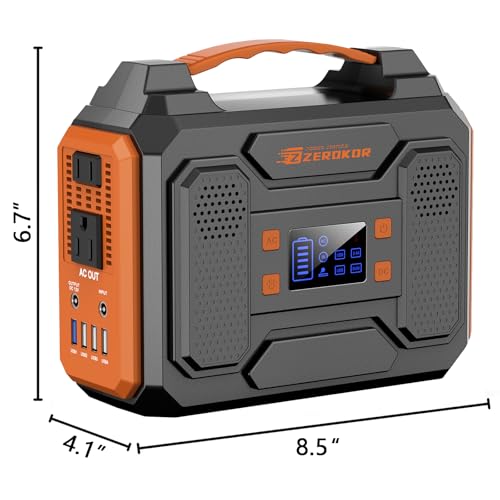
 Portable Solar Generator 300W Portable Power Station with8.5 x 6.7 x 4.1 inches5.08 poundsCheck on Amazon
Best Camping Solar Panel and Battery Kit: Bundles vs Components, Balanced by Arithmetic
The Solar Generator Bundle: One Box, One Warranty, One Throat to Choke
The bundle’s virtues are the beginner’s and the busy camper’s: the controller is inside, the connectors match because one maker chose them, the display speaks in percentages a tired camper reads by firelight, and the warranty is a single conversation. Its honest costs are the premium per watt-hour over the component parish, the proprietary panel connectors that make a second panel a brand decision, and the battery’s unswappability, which sets the kit’s lifespan by its chemistry’s calendar. For the camper whose electrical ambitions end at the camp’s needs, the bundle is not the lazy choice but the correct one, its premium buying the evenings that the component camper spends with a multimeter, which are evenings the bundle camper spends at the fire. The table’s leaders live here because most readers do, and their grades weigh the panel’s inclusion honestly: a bundle whose panel is sized to its battery is a system; a bundle whose panel is a token is a station with a brochure.
The Component Kit: Cheaper Watts, Forever Repairable
The component parish deserves its full paragraph because for the handy budget camper it is the value summit of the entire category: a rigid or folding 100-to-200-watt panel, an MPPT controller, a LiFePO4 battery of honest capacity, and an inverter sized to the loads, assembled for a total commonly well under the equivalent bundle, with every part replaceable, upgradable, and understandable. Its costs are the assembly’s afternoon, the wiring’s workmanship being the system’s safety, fuses placed as the manuals direct, terminals tight and insulated, and the absence of the bundle’s single display, the camper reading state of charge from the controller or a battery monitor added to the list. The safety law scales with the parish: a component system is a small electrical installation, deserving the respect of correct cable gauges, polarity checked twice, and the lithium cold rule wired into the household’s habits rather than the BMS alone. For the camper who will expand, a second panel next year, a bigger battery the year after, the components are not a kit but a foundation, and this guide’s table includes the parish’s standard-bearer with its assembly honestly priced in time.
Panel Manners at Camp: Angles, Shade, and Cable Length
Whichever parish, the panel’s camp behavior decides the harvest, and its manners are a kit feature to shop for: kickstands that hold an angle against a breeze, a cable long enough to let the panel sit in the clearing while the battery rests in the tent’s shade, since a battery baking in the sun beside its panel is aging for the privilege, and a folded size that packs with the camp’s geometry rather than against it. The daily liturgy is the same as every solar article on this site prescribes: out at breakfast, angled at the sun, nudged at midday, gathered before the dew, the gauge read at supper like a fuel warning. The kit that makes the liturgy easy, light panel, long cable, quick connectors, earns harvest the specification sheet cannot promise, because a panel left folded by a tedious setup gathers exactly zero watts with perfect efficiency, and the history of camping solar is largely the history of that sentence.
Best Camping Solar Panel and Battery Kit: Quick Comparison
| Solar Kit | Key Specs | Best For | Typical Price Range | Rating |
|---|---|---|---|---|
| Jackery Solar Generator 1000 Plus / 1000 v2 + SolarSaga 100/200 class | 1000Wh+ LiFePO4 class in line, matched panel bundles positioning, expandable in line | Best camping solar panel and battery kit overall | $700 – $1,200 as bundle by model and sale | 4.7 / 5 |
| BLUETTI AC180 + PV200 class | 1152Wh LiFePO4 in line, 200W panel pairing positioning, fast charging in line | Best balanced mid-size bundle | $750 – $1,100 as bundle by sale | 4.6 / 5 |
| EcoFlow DELTA 2 + 220W panel class | 1024Wh LiFePO4 in line, expandable battery options positioning, fast charge | Best expandable bundle | $800 – $1,250 as bundle by sale | 4.6 / 5 |
| Renogy 200W Starter Kit + 100Ah LiFePO4 + inverter (DIY) | Component kit in class, MPPT controller in line, 1280Wh battery class, camper-assembled | Best value and repairability | $600 – $900 total by components | 4.5 / 5 |
| Anker SOLIX C1000 + 200W panel class | 1056Wh LiFePO4 in line, compact design positioning, fast charging in line | Best compact big kit | $750 – $1,150 as bundle by sale | 4.5 / 5 |
| Goal Zero Yeti 1000X / 1500X + Boulder 100/200 class | Lithium in line, panel ecosystem positioning, established outdoor brand | Best brand ecosystem kit | $1,100 – $1,800 as bundle by model | 4.3 / 5 |
Portable Solar Generator 300W Portable Power Station with 60W Solar Panel | 110V Pure Sine Wave 280Wh Battery Solar Power Pack with USB QC3.0 DC AC Outlet for Camping Smart Device RV Van Outdoor-Orange




As an Amazon Associate we earn from qualifying purchases. Product prices and availability are accurate as of the date/time indicated.

Jackery Solar Generator 1000 v2 and 200W Solar Panel,1024Wh LiFePO4 Battery | 1500W (3000W Peak), 50-Min Fast Charge, 10ms UPS Solar Generator for Home Emergency, Camping & RV


As an Amazon Associate we earn from qualifying purchases. Product prices and availability are accurate as of the date/time indicated.
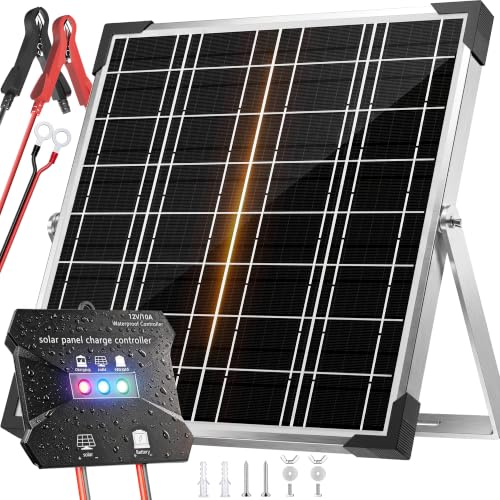
Voltset 20W 12V Solar Panel Battery Charger Trickle Maintainer Kit | Smart Charge Controller, Waterproof, Safety Protections, for Car Boat RV Marine Trailer Automotive Trailer Truck Motorcycle


As an Amazon Associate we earn from qualifying purchases. Product prices and availability are accurate as of the date/time indicated.
Prices shown are approximate and for reference only. Prices change often, so please check the current price on Amazon before you buy.
Capacities and panel ratings refer to the makers’ published specifications; bundle contents and street prices vary strongly with sales and panel count. Ratings are editorial for budget camping, weighing system balance, usable capacity, chemistry and lifespan, ease of use, and total kit value.
The Six Camping Solar Kits Reviewed
1. Jackery Solar Generator 1000 Class: Best Overall Kit
Jackery’s kilowatt bundles lead on balance: LiFePO4 capacity sized to a real camp’s weekend, panels offered in the counts that can actually refill it, and an interface the whole family operates without a manual at the fire. Its connector parish is its own, the bundle’s standing tax. For the camper buying the system once, it is the recommendation defended first.
2. BLUETTI AC180 + PV200: Best Balanced Mid-Size
The AC180 pairing is the arithmetic of the introduction made purchasable: a 200-watt panel honestly matched to a kilowatt-hour battery, fast wall charging for the forgotten eve of departure, and LiFePO4 longevity. Its fan speaks under heavy load. For the fridge-and-CPAP camp at a mid budget, it is the balanced answer.
3. EcoFlow DELTA 2: Best Expandable
The DELTA 2’s expansion batteries let the kit grow with the camp’s ambitions, this year’s station becoming next year’s basecamp without a replacement, on EcoFlow’s fast-charging, app-fluent platform. The expansion’s cost is tomorrow’s decision, stated plainly. For the household whose loads are still growing, it is the future-proof row.
4. Renogy Component Kit: Best Value and Repairability
The Renogy assembly is the budget summit for the handy: a 200-watt starter kit’s panel and MPPT controller, a 100Ah LiFePO4 battery, and an inverter, totaling under the bundles with more capacity and eternal repairability. Its price is an afternoon and a careful hand with the wiring, fuses placed and polarities doubled-checked as the text commands. For the camper who reads manuals as recreation, nothing else is close.
5. Anker SOLIX C1000: Best Compact Big Kit
Anker compresses the kilowatt class into the tidiest box in the table, with fast charging and the brand’s charging pedigree, its panel bundles sized in the same spirit. Its surge and port parish are the compact class’s. For the smaller vehicle and the neat packer, it is the big kit that fits.
6. Goal Zero Yeti Kit: Best Ecosystem
Goal Zero’s kits sell the decade’s support and the accessory ecosystem, panels and lights and mounts in one outdoor-born catalog, at the table’s proudest prices and with chemistry varying by model for the specification reader. For the camper building a whole solar camp across seasons under one brand’s wing, it remains the established road.
Buying Guide: How to Choose a Camping Solar Panel and Battery Kit
Step One: Write the Load List and Strike the Exiles
Begin with the camp’s honest day in watt-hours, every light, phone, camera, and laptop listed with its hours, the CPAP read from its own label with its heater settings confessed, the fridge’s daily appetite in your camping season’s heat. Sum it, multiply by the sunless margin your trips require, a night and a grey morning at minimum, and let the total elect the battery class. Strike the resistive exiles in the same ink, heater, kettle, hair dryer, and air conditioning, whose absence from the plan is what makes the plan achievable, and price the kit that remains rather than mourning the one physics forbids. The list, taped inside the camp box’s lid, is the system’s founding document and the answer to every future argument about what the kit should run.
Step Two: Balance the Panel to the Battery and Choose Your Parish
Apply the introduction’s balance rule with the seller’s numbers discounted to the camp’s reality: the panel array’s honest daily harvest, roughly four to five times its rated watts in watt-hours on a good day, should meet the daily load with the battery as the reserve rather than the source. Then elect the parish by your own hands: the bundle for the camper whose time is worth more than the premium and whose system will not grow; the components for the handy camper, the expander, and the strictest budgets, with the assembly’s tools and the manuals budgeted as part of the purchase. Confirm the connectors and cables in this step, panel lead lengths above all, since the clearing and the tent are never the same place and the kit’s harvest is decided by that distance.
Step Three: Rehearse the Whole System at Home
Assemble or unbox the kit in the driveway and run a full home camp night on it, the CPAP and the fridge included, reading the morning’s reserve as the only specification that was ever real. Practice the panel’s liturgy in the yard, setup timed, angle set, cable run to the shaded battery, until the campsite version is a five-minute habit rather than a project. In cold seasons, wire the lithium law into the household: charge only above freezing, the battery warmed in the tent or the vehicle, the midday window used for the winter harvest. Store the kit between trips at partial charge in the cool house, topped on the eve of departure, and let the second season’s first trip inherit a system already proven, which is the entire difference between camping solar as a hobby and camping solar as a utility.
Frequently Asked Questions About Camping Solar Kits
Is a solar generator bundle or a DIY component kit better for camping?
Better is a parish question, and the article’s answer is a census of your own hands and plans. The bundle wins for the camper who wants the system to disappear: one purchase, matched parts, one warranty, a display that speaks plainly, at a premium per watt-hour that buys back its cost in unspent evenings. The component kit wins for the handy camper and the growing system: cheaper capacity, every part replaceable at a general store’s or a solar shop’s counter, expansion by addition rather than replacement, at the price of an assembly afternoon and the responsibility for the wiring’s workmanship, fuses, gauges, and polarity, which are safety items and not aesthetics. Neither parish shames the other, and many households migrate, the first system a bundle that teaches the loads, the second a component build sized by that education. Buy the one your household will actually maintain, because a solar kit’s worst enemy is not weather but the owner who never understood it well enough to forgive it.
How many watts of solar panel does a camping kit need?
Enough to harvest the camp’s daily load on a good day, by the balance rule of Step Two: compute the day in watt-hours, then divide by the four-to-five honest sun hours a well-tended camp panel delivers, and the quotient is your array’s rated watts, before the margin your climate argues for. In practice the lights-and-phones camp lives happily on 100 watts; the fridge or CPAP camp belongs in the 200-watt parish; and the basecamp running both plus a family’s devices should look at 300 to 400 watts of panel against a battery in the kilowatt class and above. Oversizing the panel is the forgivable direction, since a surplus harvest merely tops the battery by noon and waits, while an undersized array is a debt collected nightly. When the budget forces a sequence, buy the battery right and the panel expandably, adding the second panel next season, because panels parallel gracefully and batteries, in the bundle parish, do not.
Can a camping solar kit run a fridge?
A 12-volt compressor fridge, yes, and it is the kit’s finest parish: the modern camping fridge averages a modest draw across the day as its compressor cycles, totaling a few hundred watt-hours in summer heat, which the kilowatt-class kits of this table carry across a night and refill from a 200-watt array across the day, ending the ice runs and the drowned sandwiches of the cooler age forever. The domestic mini-fridge on the inverter is a poorer bargain, its startup surges and its insulation arguing against it, and the absorption three-way fridges belong to propane’s parish entirely. Size the kit by the fridge’s own label and your season’s heat, keep the fridge shaded and its vents breathing, pre-chill it at home on the wall, and the system’s arithmetic holds with the lights and phones riding along. It is the load that converts skeptics, because a cold drink on the fourth day, silent and solar, is the kit’s whole philosophy served at temperature.
What happens to the kit in winter camping?
Winter tests the system’s two honest limits, and both are manageable with the knowledge in hand. The harvest shrinks: the sun rides low and late, the days shorten, and the panel’s liturgy matters more, steeper angles, every clear hour used, the array brushed of frost and snow, with the battery’s reserve carrying the long night as the plan’s assumption rather than its surprise. The chemistry tightens: discharge continues in the cold at reduced capacity, but charging below freezing is forbidden to lithium cells, protected by the better kits’ own management systems and by the camper’s discipline where it is not, the battery kept in the tent’s or the sleeping vehicle’s relative warmth and charged in the warmed midday. The winter camper who plans for both, a bigger reserve and a warmer battery, finds the kit as faithful in January as in June; the one who discovers them at the campsite learns why this site prints the cold rule in every battery article it publishes, including, the reader will have noticed, this one.
Related guides
- Best Tent When Tent Is Too Heavy in 2026: Best Tent When Tent Is Too Heavy for Light Packing, Easy Carry, and Simple Camping
- Camping Table in 2026: The Complete Budget Guide to Choosing a Camping Table That Fits Your Chairs, Your Car, and Your Cook Kit, From Coleman and ALPS Mountaineering to KingCamp and Trekology
- Best Camping Stove for Budget Camping in 2026: Affordable Two-Burner and Single-Burner Camping Stoves
- Camping Chair in 2026: How to Choose a Comfortable, Durable Chair That Fits Your Car, Your Body, and Your Campsite
More from Amazon
Programs that pair well with the guide above. Offers and eligibility are set by Amazon and may change.
Free shipping on eligible items, Prime Video and more. Eligible new members can start with a free trial.
Start a Prime free trialA Prime membership for ages 18-24 with a trial period. Eligibility is set by Amazon.
See Prime for Young AdultsAudiobooks and podcasts to listen to on the go. Eligible new members can start with a free trial.
Try Audible freeAd-free music streaming. Eligible new subscribers can start with a free trial.
Try Music Unlimited freeAs an Amazon Associate we earn from qualifying purchases.

Write Your Review
No reviews yet. Be the first to share your experience!