
What's inside
- Understanding the Best Battery Pack for Heated Camping Chair Systems
- Quick Comparison: Best Battery Pack for Heated Camping Chair Models
- Detailed Reviews: Best Battery Pack for Heated Camping Chair Picks
- Buying Guide: Choosing the Best Battery Pack for Heated Camping Chair
- Frequently Asked Questions About Best Battery Pack for Heated Camping Chair
As an Amazon Associate I earn from qualifying purchases. This post may contain affiliate links at no extra cost to you.
The best battery pack for heated camping chair is, before it is anything else, the right battery for your chair — and in this small, practical category, right has a precise meaning. Heated camping chairs are not one electrical species. Some are built around a USB power bank, sipping 5 volts through a USB connection and expecting the kind of pack you also charge a phone with. Some are built around a manufacturer’s own removable battery, commonly in the 7.4-volt or 12-volt class of the chair maker’s system, which fits its own pocket, its own connector, and nothing else in your kit. Some, at the heavy end, are built around tool batteries, the 18-volt and 20-volt platforms from Milwaukee, DeWalt, and their peers, adapted or native, which trade a little elegance for a great deal of runtime and a battery you may already own by the dozen. A pack that cannot connect to your chair, or connects at the wrong voltage, is not a bargain at any price. It is a paperweight with a charge indicator.
This guide therefore works in the order the problem demands. First, identify your chair’s system from its maker’s stated requirements — voltage, connector, and whether the chair ships with a battery and expects its own, accepts a standard USB power bank, or adapts to a tool platform. Then choose within that system, where the real decisions live: capacity in watt-hours, which is the only honest runtime currency across voltages; output stability in the cold, because a camping chair is used in exactly the temperatures that shrink a battery’s effective capacity; pocket fit and cable routing, because a pack that does not sit where the chair’s pocket expects it will migrate, pull, and disconnect at the moment the evening gets comfortable; and charging logistics, because a pack that takes all night to refill is a one-evening device on a three-evening trip. The table compares real, currently sold packs across all three systems — USB power banks from Anker and its peers, chair-system batteries of the kind sold by the heated chair makers themselves, and the tool battery platforms — labelled by system, so you can shop inside your own row. A warm seat is a simple pleasure. Keeping it warm past the second hour, on the second night, is a specification, and it is purchasable if you read the chair’s requirements before the pack’s marketing.
Safety in this category is electrical and thermal, and it is not decorative. Use only a battery of the voltage and connector type your chair’s maker specifies, never adapt a higher-voltage pack to a lower-voltage chair with a homemade cable, never charge a pack inside the chair’s pocket or leave any lithium battery charging unattended, and retire any pack that is swollen, damaged, hot in ordinary use, or has been crushed in a packed car — a damaged lithium battery is a fire risk, and it is disposed of through a battery recycling route, never in general waste and never in a campfire, a sentence this guide hopes is unnecessary and includes anyway. Keep packs dry, out of the chair when the chair is stored damp, and charged and stored by their makers’ stated guidance. A heated chair is a comfort device. Run its electrics with the respect any battery near fabric and a sleeping camper deserves.
Our Top Picks
 Lyzuepely 20000mAh 5V2A Battery Pack for Electric Heated5.3 x 2.5 x 1.2 inches0.9 poundsCheck on Amazon
 UMEIDEA 20000mAh 5V2A Battery Pack for Electric Heated3.75 x 2.25 x 0.95 inches0.9 poundsCheck on Amazon
Understanding the Best Battery Pack for Heated Camping Chair Systems
Step Zero: Name Your Chair’s System Before You Shop
Find your chair’s electrical identity in its maker’s stated details — on the chair’s label, in its manual, or on the maker’s page for the exact model — and write down three facts. The voltage: 5V USB, a maker’s 7.4V or 12V system, or a tool platform’s nominal voltage, each a different world. The connector: a standard USB-A or USB-C port, a barrel connector of a stated size, or a proprietary fitting, because voltage twins with different connectors are still strangers. And the maker’s own battery position: whether a battery is included with the chair, sold as its spare, or deliberately left to the buyer’s power bank drawer, which tells you whether you are shopping for a spare, a replacement, or the chair’s first and only pack. Armed with those three facts, the table below resolves into one relevant row family and five interesting but irrelevant ones. Shopping without them resolves into a return. This is the cheapest research in the entire guide, and it is also, in this category, the difference between the product working and not working, with no middle state.
Capacity in Watt-Hours: The Only Runtime Number That Travels
Capacity is printed on power banks in milliamp-hours, a figure that cannot be compared across voltages, because a 10,000mAh pack at 5 volts and a 10,000mAh pack at a higher voltage hold very different amounts of energy. The honest unit is the watt-hour — volts multiplied by amp-hours — and every reputable pack states it or lets you compute it from its stated figures, because airlines require it and engineers respect it. Runtime is then an estimate you can actually make: divide the pack’s watt-hours by the chair’s draw in watts on the heat setting you will use, both from the makers’ stated figures where they give them, and treat the result as a ceiling that cold weather will tax. A heated chair’s settings commonly step its draw substantially between low and high, so the same pack that runs an evening on low may run half an evening on high, which is why experienced heated-chair campers run low as the default and high as a warm-up, in the pattern of every heated garment ever made. In the cold, lithium batteries deliver less of their rated energy and deliver it more reluctantly, so a pack bought to exactly meet a summer evening’s arithmetic will fall short on a frosty one. Buy capacity with a winter margin — a third more than your estimated need is this guide’s working rule — and keep the pack warm in an inside pocket until it goes into the chair, because a warm battery is a bigger battery, for free.
Pocket Fit, Cables, and the Runtime Nobody Prints
The third specification is physical. A heated chair has a battery pocket, commonly at the back or side of the seat, sized for its own system’s pack, and a cable of a fixed length routed to the heating elements. A replacement or upgrade pack must fit that pocket without straining its seams, sit without a hard corner in the sitter’s back, and connect without the cable being stretched, pinched under a frame member, or left dangling where a boot or a chair leg will find it. Tool-battery setups move the problem rather than solving it: the adapter and battery commonly ride in the pocket or a pouch as the system’s maker directs, heavier and bulkier, repaid in runtime and in the ability to swap a flat battery for a fresh one in ten seconds. Test the whole arrangement at home, seated, for an evening, because a pack that disconnects when you shift your weight is a runtime of however long you sit still, whatever its watt-hours say. Charge time closes the practical brief: on a multi-night trip, a pack must refill from the car’s USB, a power station, or a site hook-up in the hours available, using a charger of the type its maker specifies, and a second pack in rotation — one in the chair, one on charge — is the seasoned answer that turns a heated chair from a first-night luxury into a whole-trip utility.
Quick Comparison: Best Battery Pack for Heated Camping Chair Models
| Model | System, Capacity and Key Specs | Best For | Typical Price Range | Rating |
|---|---|---|---|---|
| Anker PowerCore 20000 class USB power bank | USB system, 20,000mAh class, watt-hours stated in maker’s terms, USB-A and USB-C ports in maker’s design, for 5V USB chairs | Best battery pack for heated camping chair in a USB chair | $35 – $55 | 4.6 / 5 |
| Chair-maker spare battery class (Gobi Heat and peers) | Maker system, voltage and connector matched to the maker’s chairs in maker’s terms, capacity stated in maker’s figures, pocket-fit by design | Best spare for a proprietary chair system | $40 – $80 by maker | 4.5 / 5 |
| Anker PowerCore 10000 class USB power bank | USB system, 10,000mAh class, compact and light, watt-hours stated in maker’s terms, for 5V USB chairs | Best light pack for short evenings | $20 – $35 | 4.4 / 5 |
| Milwaukee M18 battery class with chair adapter systems | Tool system, 18V platform, capacities by battery size in maker’s line, adapter required as the chair or adapter maker directs | Best runtime for tool-platform households | $80 – $180 by battery size, adapter extra | 4.4 / 5 |
| DeWalt 20V MAX battery class with chair adapter systems | Tool system, 20V MAX platform, capacities by battery size in maker’s line, adapter required as the chair or adapter maker directs | Best for DeWalt households running long evenings | $80 – $170 by battery size, adapter extra | 4.3 / 5 |
| Jackery and portable power station USB output class | Basecamp system, chair powered from a power station’s USB ports in maker’s terms, capacity by station size, not a pocket pack | Best for a fixed basecamp with a short cable run | $150 – $300 by station | 4.2 / 5 |
Lyzuepely 20000mAh 5V2A Battery Pack for Electric Heated Camping Chair, Heated Blanket, Heated Hunting Seat Pad, Heated Sleeping Bag USB Power Bank for Camping Work(Only Battery Pack)


As an Amazon Associate we earn from qualifying purchases. Product prices and availability are accurate as of the date/time indicated.
UMEIDEA 20000mAh 5V2A Battery Pack for Electric Heated Camping Chair, Heated Blanket, Hunting Seat Pad, Sleeping Bag USB Power Bank Camping Work Power (Black, Milliamp Hours, 20000)


As an Amazon Associate we earn from qualifying purchases. Product prices and availability are accurate as of the date/time indicated.
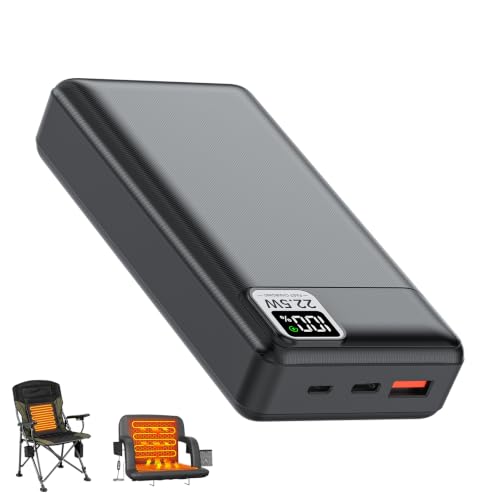
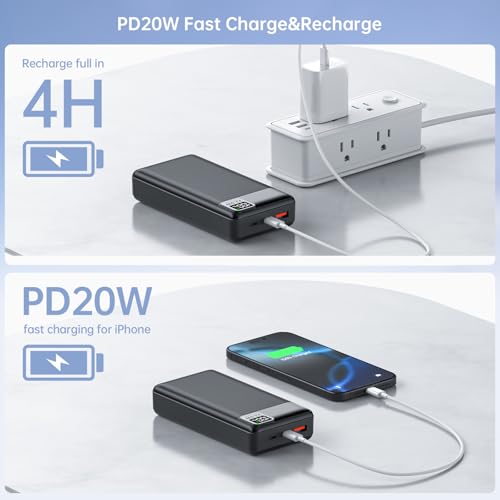
VINTELEIN 5V 2A 3A 20000mAh Battery Pack PD20W Fast Charging Power Bank | For Electric Heated Camping Chair/Stadium Seat/Blanket/Vest/Jacket/Red Light Therapy Pad, for iPhone/iPad, Digital LCD Screen



As an Amazon Associate we earn from qualifying purchases. Product prices and availability are accurate as of the date/time indicated.
Systems are not interchangeable: a pack must match your chair maker’s stated voltage and connector, and tool batteries require the specific adapter the chair maker or adapter maker provides for that combination, used exactly as its maker directs. Capacities in milliamp-hours are stated at each pack’s own voltage; compare across systems in watt-hours, which reputable makers state. Runtime depends on the chair’s draw at each heat setting and on temperature, and must be estimated from both makers’ stated figures, not from a headline. Prices are typical retail ranges and vary by capacity, retailer, region, and promotion. Ratings are editorial within each system: capacity and cold-weather honesty, pocket fit and connection security, charge convenience, build and safety documentation, and value.
Detailed Reviews: Best Battery Pack for Heated Camping Chair Picks
1. Anker PowerCore 20000 Class – Best for USB Chairs
For the large family of heated chairs built around a 5V USB connection, a quality 20,000mAh-class power bank is the sweet spot, and Anker’s PowerCore line is its standard bearer: stated watt-hours you can plan with, ports that also rescue the camp’s phones, a build and safety record from the category’s most established name, and a size that fits most chairs’ pockets as the chair makers, who design around exactly this class of pack, intended. On a low-heat default with high for warm-ups, it is the one-evening-and-then-some pack, and in rotation as a pair it is a whole trip. If your chair is USB, start and very likely finish here.
2. Chair-Maker Spare Battery Class – Best for Proprietary Systems
Where a chair runs on its maker’s own battery — the Gobi Heat pattern and its peers across the heated chair market — the maker’s spare is not a lack of imagination. It is the guaranteed fit: correct voltage, correct connector, correct pocket dimensions, and a runtime the chair’s own manual can state in hours because the system is closed. Buy the spare when you buy the chair if the trip is long, because proprietary batteries are the item a campsite shop will never stock, and run the pair in rotation. This row’s rating assumes you confirm the spare matches your exact chair model in the maker’s fit list, because within a maker’s line, systems change.
3. Anker PowerCore 10000 Class – Best Light and Short
The 10,000mAh class is the evening pack: half the size and weight of its big sibling, enough for a few hours of low-to-medium heat in a USB chair by the arithmetic in this guide, and small enough to live in the chair’s pocket all season so the heat is always there for the chilly half hour that was not worth a bigger production. It is the second pack in many seasoned setups — the light one for short sits, the big one for long evenings — and as a sole pack it suits the camper whose heated hours are the campfire hours and no more.
4. Milwaukee M18 Class – Best Runtime for Tool Households
A household already invested in Milwaukee’s M18 platform owns, in its tool batteries, the largest pocketable energy in this table, and chair or adapter systems that accept them convert a heated chair into an all-evening, swap-in-ten-seconds appliance. The conditions are this guide’s own, at full strength: only with the adapter made for the combination, only as its maker directs, with the voltage conversion handled by that adapter’s design and never by improvisation, and with the bulk accepted as the price. For the M18 household on a cold trip, no USB pack is in the argument.
5. DeWalt 20V MAX Class – Best for the Other Tool Household
The same argument in yellow: DeWalt’s 20V MAX batteries, in their range of sizes, give a heated chair setup a runtime and a swap logistics that USB cannot approach, through the adapters made for the purpose, used as their makers direct. Choose the battery size by the chair’s pocket or pouch arrangement and the evening’s length rather than by the biggest number, because the largest tool batteries are heavy enough to change how a chair’s pocket carries. For a DeWalt household, the marginal cost of the system is an adapter, which is the cheapest runtime in this guide.
6. Power Station USB Class – Best for a Fixed Basecamp
A portable power station at a fixed basecamp — the family pitch, the festival camp, the hunting camp — can power a USB heated chair from its USB ports across an evening with capacity to spare, at the cost of a cable run that tethers the chair to the station’s spot. It is the wrong answer for a chair that moves around a fire and the right answer for a camp command chair that does not, and it doubles as the charging hub for the pocket packs in rotation. This guide lists it as a system to recognise, not a pack to pocket, which is the honest shape of its row.
Buying Guide: Choosing the Best Battery Pack for Heated Camping Chair
Do the Runtime Arithmetic for Your Chair, Your Setting, Your Season
Take your chair maker’s stated draw or runtime figures and your pack candidate’s stated watt-hours, and do the division for the heat setting you will actually live on, which for most campers is low, with high reserved for the first ten minutes. Compare the answer with your real evening, campfire to bedtime, and then apply the season’s tax: a pack working at near-freezing temperatures delivers meaningfully less than its label, so the winter margin in this guide — buy a third more capacity than the fair-weather arithmetic says — is the difference between a specification and a warm seat at hour four. If the chair maker states runtime per pack directly, trust it over your arithmetic and still keep the margin, because their test evening was probably warmer than yours. Where two packs are in rotation, size each for a full evening rather than splitting one evening across both, because rotation works by evenings, not by halves.
Fit the Pocket, Route the Cable, Test the Evening at Home
Before the trip, assemble the whole system at home and sit in it for a real evening: pack in the pocket, cable routed as it will live, chair folded and unfolded with the pack in place, because folding is where cables get pinched and pockets get strained. Shift your weight, lean, get up and sit down twenty times, and confirm the connection never blinks, because a connector that interrupts in the living room will resign entirely on a frosty field. Check the pocket’s seams under the pack’s weight and corners, and if the pack is a third-party fit in a maker’s pocket, pad a hard corner rather than letting it work on the fabric for a season. Set the charging routine the trip will use — car USB on the drive, a power station at camp, a hook-up where the site provides one, always with the pack’s specified charger type, never inside the chair’s pocket, never unattended — and label packs and their charge state with the camp’s usual tape-and-marker honesty, because at dusk all black rectangles look charged.
Care for the Batteries Like the Fire-Adjacent Devices They Are
Store packs by their makers’ stated guidance, commonly at a partial charge for a long off-season, in a cool, dry place, out of the chair, and never in a car through a hot summer or a freezing winter if the household has any alternative. Inspect before every trip for swelling, cracking, damaged cables, and connectors that have loosened, and retire anything suspect through a battery recycling route — a swollen pack is not a runtime problem to be managed but a hazard to be removed, carefully, uncharged and unused, to the recyclers. Keep packs and chairs dry as a system, dry a damp chair fully before its pocket receives a battery again, and teach the whole camp the two rules that cover the category: only the right pack in the right chair, and a hot, swollen, or damaged pack is nobody’s problem to solve at a campsite, it is everybody’s cue to stop using it. Do that, and the best battery pack for heated camping chair becomes the invisible half of a simple luxury — a warm seat, all evening, every evening of the trip, in the cold that made the chair worth buying in the first place.
Frequently Asked Questions About Best Battery Pack for Heated Camping Chair
What is the best battery pack for a heated camping chair?
The one that matches your chair’s system, in the capacity your evenings need. For a USB chair, the Anker PowerCore 20000 class is the best all-round pack, with the 10000 class as the light option for short sits. For a chair on its maker’s own battery system, the maker’s spare for your exact model is the best and usually the only correct buy. For a household on a tool platform, Milwaukee M18 or DeWalt 20V MAX batteries through the adapter made for the combination give the longest runtime and instant swaps. Confirm voltage and connector from your chair maker’s stated requirements before anything else, compare capacities in watt-hours rather than milliamp-hours, and buy a third more capacity than a fair-weather evening’s arithmetic suggests, because cold is a tax every camping battery pays.
How long will a battery pack run a heated camping chair?
Estimate it from the two makers’ figures: the pack’s stated watt-hours divided by the chair’s draw in watts at the heat setting you use. As a working picture, a 20,000mAh-class USB power bank — roughly 74 watt-hours in its maker’s stated terms — runs a typical USB heated chair for a full evening on low, and substantially less on high, which is why experienced users warm up on high and live on low. Cold shortens every estimate, a chair maker’s own stated runtime for its own battery is the most trustworthy figure in the category, and a second pack in rotation is the reliable way to make runtime a non-issue across a multi-night trip. If a seller promises runtimes far beyond what the watt-hour division supports, believe the division.
Can I use any power bank or tool battery with my heated chair?
No. A battery must match the chair maker’s stated voltage and connector, full stop. A standard USB power bank suits only chairs designed for 5V USB power. A chair on a proprietary battery takes that maker’s battery for its exact model. A tool battery suits only a chair or adapter system designed for that platform, with the adapter handling the connection and any voltage conversion as its maker engineered it — never improvise a cable between a high-voltage tool battery and a chair, and never force a connector that resists. The chair’s label and manual state its requirements, the pack’s stated figures must meet them, and where the two documents disagree with a listing’s enthusiasm, the documents win.
How should I charge and store heated chair batteries on a camping trip?
Charge with the charger type the pack’s maker specifies — commonly a USB charger of a stated output for power banks, the maker’s own charger for proprietary and tool batteries — out of the chair’s pocket, on a stable surface, attended as all lithium charging should be, and build the trip’s rhythm around it: one pack in the chair, one on charge from the car, a power station, or a hook-up where available. Keep packs dry and, until use, warm in cold weather, because a cold battery delivers less of its charge. At home, store packs out of the chair, in a cool dry place at the maker’s recommended storage charge, inspect them before every trip, and recycle any that are swollen, damaged, or hot in ordinary use through a battery recycling route. Never dispose of a lithium battery in general waste or fire.
Related guides
- Best Walkie Talkies for Camping and Kayaking in 2026: Midland, Motorola, Cobra, and Rocky Talkie Radios Compared for Waterproofing, Honest Range, Floating Designs, and Keeping a Group Together on Land and Water
- Best Lithium Battery for Camping in 2026: Lithium Battery for Camping, Lithium Camping Batteries, and Best Camping Batteries
- Best Camping Kayaks Under 500 in 2026: 7 Best Camping Kayaks Under 500 Dollars That Are Stable, Roomy, and Built for Camping
- Best Stove for Kayak Camping in 2026: 7 Best Stoves for Kayak Camping That Are Light, Compact, and Boil Fast
More from Amazon
Programs that pair well with the guide above. Offers and eligibility are set by Amazon and may change.
Free shipping on eligible items, Prime Video and more. Eligible new members can start with a free trial.
Start a Prime free trialA Prime membership for ages 18-24 with a trial period. Eligibility is set by Amazon.
See Prime for Young AdultsAudiobooks and podcasts to listen to on the go. Eligible new members can start with a free trial.
Try Audible freeAd-free music streaming. Eligible new subscribers can start with a free trial.
Try Music Unlimited freeAs an Amazon Associate we earn from qualifying purchases.

Write Your Review
No reviews yet. Be the first to share your experience!