
What's inside
- What Makes the Best Inflatable Kayak for Camping Different
- Quick Comparison: Best Inflatable Kayaks for Camping Compared
- Best Inflatable Kayak for Camping: The Six Reviewed
- Buying Guide: How to Choose the Best Inflatable Kayak for Camping
- How We Selected the Best Inflatable Kayaks for Camping
- Top Picks for Inflatable Camping Kayaks
- Frequently Asked Questions About the Best Inflatable Kayak for Camping
As an Amazon Associate I earn from qualifying purchases. This post may contain affiliate links at no extra cost to you.
The best inflatable kayak for camping solves a very specific problem. You want to paddle at the lake, river, or coastal campsite, but you do not have a roof rack, you do not have garage space for a 12-foot hard-shell boat, and you do not want to spend your whole gear budget on a kayak you use six weekends a year. An inflatable packs into a duffel, rides in a trunk or back seat, inflates in minutes at the shore, and, if you choose well, paddles far better than the pool-toy reputation suggests.
Choosing well is the hard part. The market splits into three very different kinds of boat wearing the same label. At the bottom are thin vinyl recreation kayaks that are fine for floating near a calm shore on a warm afternoon and disappointing almost everywhere else. In the middle are reinforced PVC and drop-stitch models that track properly, carry camping loads, and survive seasons of use. At the top are expedition-grade inflatables with rigid floors, real keels, and prices approaching hard-shell boats. For camping, the middle is usually the sweet spot, but the right choice depends on whether you paddle solo or tandem, on flat lakes or moving rivers, and on whether the kayak must also carry gear to a paddle-in site.
Safety comes before any comparison. Wear a properly fitted, approved life jacket every time you are on the water, not just when conditions look rough. Check local rules for registration, launch permits, and life jacket requirements, dress for the water temperature rather than the air temperature, tell someone ashore where you are going and when you expect to return, and never paddle beyond the calmest conditions your boat and skills are rated for. An inflatable that is perfect for a sheltered lake is not automatically safe on a cold river or an exposed bay.
What Makes the Best Inflatable Kayak for Camping Different
A kayak bought only for day paddling can get away with compromises a camping kayak cannot. Camping adds load, distance, repetition, and remote launches, and each of those exposes a different weakness.
Capacity Is About Working Load, Not a Headline Number
Manufacturers publish a maximum capacity, but a boat loaded to that number sits low, paddles slowly, and ships water over the sides in small chop. For camping, treat the published limit as a ceiling you stay well under. Add your weight, your partner’s weight if it is a tandem, the weight of water, food, and overnight gear, and the pump and repair kit, then leave a comfortable margin. If your real load is close to the limit, buy the next size up. A slightly longer boat that floats high is faster, drier, and safer than a compact boat ridden deep.
Tracking Decides Whether the Trip Is Fun
Cheap inflatables yaw from side to side with every stroke because nothing underneath resists the turn. Better models fix this with removable skegs, moulded fins, rigid drop-stitch floors, and longer waterlines. If your campsite sits across a lake or a mile up a slow river, tracking matters more than almost any other feature. Short, wide boats are stable and playful near shore, but they punish you on a crossing, especially into a headwind, when an inflatable’s light weight and high sides make it drift more than a hard-shell kayak.
Material and Chambers Decide How It Ages and How It Fails
Look for multiple separate air chambers, so one puncture does not deflate the whole boat, and for reinforced PVC, nylon covers, or drop-stitch construction rather than thin single-layer vinyl. Boston valves and high-quality inflation valves speed setup and hold pressure through temperature changes. Every inflatable should travel with its repair kit, and you should practise a repair at home before you need one at a campsite. Rinse sand and grit from valves after beach launches, dry the boat fully before storage, and keep it out of prolonged direct sun when it is inflated on shore, because heat raises internal pressure.
Quick Comparison: Best Inflatable Kayaks for Camping Compared
| Inflatable Kayak Model | Best For | Key Specs | Typical Price Range | Rating |
|---|---|---|---|---|
| Advanced Elements AdvancedFrame | Best overall for camping | Solo, about 10 ft 5 in, built-in aluminium ribs, fabric-covered PVC, multiple chambers, skeg tracking | $500 – $650 | 4.7 / 5 |
| Intex Excursion Pro K2 | Best value tandem | Two-person, about 12 ft 7 in, reinforced PVC, removable skegs, adjustable seats, fishing rod holders | $180 – $280 | 4.5 / 5 |
| Sea Eagle 370 Pro | Best for durability and load | Two to three person, about 12 ft 4 in, reinforced hull material, inflatable keel, high published capacity | $330 – $430 | 4.6 / 5 |
| Aquaglide Navarro 130 | Best for cooler weather and coverage | Solo, about 13 ft, covered deck design, drop-stitch floor, spray and wind protection | $450 – $600 | 4.6 / 5 |
| Advanced Elements StraitEdge | Best for mixed flat and moving water | Solo, about 9 ft 8 in, self-bailing ports that can be opened or closed, wide stable hull, aluminium ribs | $450 – $580 | 4.5 / 5 |
| Intex Challenger K2 | Best budget starter for calm lakes | Two-person, about 11 ft 6 in, vinyl construction, removable skeg, cargo net, best kept to sheltered water | $90 – $150 | 4.2 / 5 |
Ratings are editorial assessments for camping use, based on the makers’ published specifications, construction, tracking aids, load handling, and value at typical prices. Prices are typical retail ranges and vary by season, package, and whether a pump and paddles are included. Always confirm what is in the box before comparing prices, because a boat sold without a pump or paddles is not as cheap as it first looks.
Best Inflatable Kayak for Camping: The Six Reviewed
1. Advanced Elements AdvancedFrame – Best Overall
The AdvancedFrame earns the top spot because it paddles more like a folding hard-shell kayak than a typical inflatable. Built-in aluminium ribs in the bow and stern give it a defined shape that cuts through water instead of pushing it, and the fabric outer cover protects the tubes from abrasion at rocky launches. For a camper who mostly paddles solo on lakes and slow rivers, it offers the best balance of tracking, portability, and durability in this group. It is not the lightest to carry inflated, and the fabric cover needs time to dry after a trip, but those are fair trades for how it performs once launched.
2. Intex Excursion Pro K2 – Best Value Tandem
The Excursion Pro K2 is the boat we recommend to couples and families who want a real step up from entry-level vinyl without a premium price. The reinforced material feels substantially tougher than Intex’s cheapest models, the seats adjust well enough for a taller paddler in the back, and the removable skegs noticeably improve straight-line paddling. It works well for campsite day trips, fishing, and short loaded runs to a nearby shore camp. Count the full package cost, including a good pump if the included one feels slow, and keep expectations realistic in wind.
3. Sea Eagle 370 Pro – Best for Durability and Load
Sea Eagle built its reputation on tough, simple boats, and the 370 Pro is the camping workhorse of this list. Its reinforced hull shrugs off the dock bumps, gravel bars, and dog claws that worry owners of thinner boats, and its generous capacity suits a paddler carrying a cooler, a dry bag, and a tent to a paddle-in site. It is wider and less sleek than the AdvancedFrame, so it is not the fastest choice, but for loaded, practical camping trips, stability and toughness often matter more than speed.
4. Aquaglide Navarro 130 – Best for Coverage and Cool Weather
Most inflatables are open, sit-on-top style boats that leave you exposed to sun, spray, and wind. The Navarro 130’s covered design is a welcome alternative for spring and autumn camping, when a cold splash stops being refreshing. The drop-stitch floor adds rigidity that helps tracking and makes standing to stretch or scout a shoreline more plausible. It suits solo campers who paddle larger lakes and want a drier ride, provided they practise getting in and out of a decked boat in shallow water first.
5. Advanced Elements StraitEdge – Best for Mixed Water
The StraitEdge is built for campers whose trips mix flat lakes with gentle moving water. Its wide hull is confidence-inspiring for beginners, and its self-bailing ports can be opened for moving water or closed for flat water so you do not sit in a puddle all day. That versatility comes with a shorter waterline, so it is happier on rivers, creeks, and smaller lakes than on long open crossings. For a camper based near varied water, it may be the most adaptable single purchase here.
6. Intex Challenger K2 – Best Budget Starter
The Challenger K2 is honest about what it is: an inexpensive way to find out whether kayak camping belongs in your life. For calm, warm, sheltered lakes, close to shore, in good weather, it gives two people an enjoyable afternoon and packs away to almost nothing. Its limits are equally clear. Thin material, modest tracking, and low freeboard mean it should not be your boat for cold water, wind, distance, or loaded overnight trips. Buy it as a starter or a spare for guests, not as an expedition boat, and it will not disappoint you.
Buying Guide: How to Choose the Best Inflatable Kayak for Camping
Start With Your Water, Your Load, and Your Car
Name your real conditions before you shop. List the lakes and rivers you will actually paddle this season, the longest distance you plan to cover, the total weight of people and gear, and how far you must carry the packed boat from car to water. Those four answers rule out half the market immediately. Calm, small lakes forgive almost anything. Big water, wind, cold, and distance demand tracking aids, freeboard, capacity in reserve, and tougher material. If you camp from the car and paddle for fun, prioritise easy setup. If you paddle to your campsite, prioritise capacity, dry storage, and durability.
Price the Whole Package, Not Just the Boat
An inflatable kayak needs a pump, paddles, life jackets for every paddler, dry bags for gear, and usually a better carry bag than the one included. Some models bundle these well and some barely bundle them at all. Add the missing pieces before you decide which boat is cheaper. Also budget for a pressure gauge if the maker recommends a specific inflation pressure. Under-inflated boats feel sluggish and unstable, over-inflated boats stress seams, especially as the sun warms them on shore, so follow the maker’s stated pressure and check it rather than guessing by feel.
Test the Shore Routine Before Your First Trip
Inflate the boat at home, sit in it, adjust the seats, practise entering and exiting, deflate it, and pack it away. Time the whole routine. At a campsite, with weather coming in or light fading, a boat that takes twice as long as expected to set up becomes a boat that gets left in the car. Practise a puncture repair on the included kit, learn where each valve is, and pack the pump and repair kit where you can reach them on the water, in a dry bag, not buried under the tent at the bottom of the boat.
Care for It Like the Gear Your Trip Depends On
Rinse the boat after use, especially after salt water or silty rivers, open the valves, and let it dry completely before folding it for storage, because trapped moisture breeds mildew in fabric covers and seams. Store it loosely rolled, out of extreme heat and away from sharp tools, fuels, and solvents. Before every launch, inspect seams, valves, and the floor, top up pressure as temperatures change, and check that skegs are attached and drain or bailing plugs are set correctly for the water you are entering. These small habits are what separate a boat that lasts one summer from one that serves for years.
How We Selected the Best Inflatable Kayaks for Camping
We included only real, named, currently sold models from established makers, with published dimensions, capacity, and construction details. We weighted tracking, working load, material durability, and the completeness of the package ahead of headline capacity and lowest price. Solo, tandem, flat-water, and mixed-water campers were assessed separately, and every model was judged for camping use specifically, including carrying gear, repeated inflation, and packing into a vehicle, under safety-focused framing throughout.
Top Picks for Inflatable Camping Kayaks
Inflatable kayaks pack into a bag, which makes them handy when trunk space is tight. These two-person sets come with paddles and a pump in most cases, so you can inflate and launch on calm water soon after arriving.
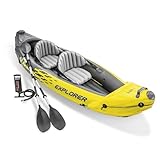
Intex Explorer K2 2-Person Inflatable Kayak Set
A popular two-person set with oars and a pump. It is an affordable pick for calm lakes and slow rivers, with a design that is easy to inflate and a size that stores in a closet or garage between trips.
As an Amazon Associate we earn from qualifying purchases at no extra cost to you.
Intex Challenger K2 2-Person Inflatable Kayak Set
A set with a longer, narrower shape that tracks better in a straight line. It suits paddlers who plan to cover more distance and want a boat that feels more purposeful than a basic pool-style inflatable.

Intex Dakota K2 Inflatable Kayak Set
A sturdier build with paddles and a pump. It is a good choice for campers who want a more durable boat for repeated outings, and it keeps the simple setup that makes inflatables so convenient.

Sea Eagle SE370 Pro Package Inflatable Sport Kayak
A tandem sport kayak sold as a package with accessories. It is a step up in build quality and a better fit for choppy water, so it suits paddlers who expect to use the kayak many times each season.

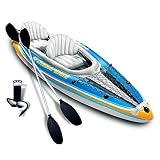
Sunlite Sports Inflatable Kayak, 2 Person
A portable two-person kayak aimed at casual trips. It is a straightforward option for families who want a simple inflatable for lakes, and it packs down small enough to fit with the rest of the camping gear.
Frequently Asked Questions About the Best Inflatable Kayak for Camping
Are inflatable kayaks safe for camping trips?
Yes, when the boat is matched to the water and used within its limits. Choose a model with multiple air chambers, wear a fitted approved life jacket, dress for the water temperature, stay in sheltered conditions appropriate to the boat, and carry the pump and repair kit on the water. A durable mid-range inflatable used sensibly on a calm lake is a sound choice; any inflatable used on cold, exposed, or fast water beyond its design is not.
How long does an inflatable kayak take to set up?
Most models in this guide inflate in roughly five to fifteen minutes with a hand or electric pump, once you have practised the sequence at home. Larger tandem and drop-stitch models take longer, and deflating, drying, and packing usually takes as long as inflating. Practise the full routine before your first camping trip so setup at the shore is routine rather than experimental.
Can an inflatable kayak carry overnight camping gear?
Many can, provided the total weight of paddlers and gear stays well below the maker’s published capacity and the gear is packed in dry bags, balanced low and centrally. Tandem and high-capacity models such as the Sea Eagle 370 Pro suit paddle-in camping best. Distribute weight evenly, keep heavy items close to the centre of the boat, secure everything so it cannot shift, and make a short loaded test paddle near shore before committing to a longer crossing.
How long will an inflatable kayak last?
A reinforced PVC or fabric-covered model that is rinsed, fully dried, stored loosely out of extreme heat, and repaired promptly should serve for several seasons of regular camping use. Thin single-layer vinyl boats are best viewed as starter or occasional-use boats. Longevity depends far more on care, storage, and staying within the boat’s intended conditions than on any single material claim, so follow the maker’s care instructions and inspect seams and valves at the start of every season.
Related guides
- Best Places for Kayak Camping in 2026: 7 Places That Offer Calm Water, Campsites, and Great Kayak Camping Trips
- Best Battery for Camping Solar in 2026: 7 Solar Batteries and Power Stations That Charge With Solar Panels and Power Your Campsite
- Stove Lightweight vs Stove Heavyweight Camping in 2026: Which Camp Stove Is Right for You?
- Best Sleeping Bag for Kids Camping Trips in 2026: 7 Sleeping Bags That Keep Kids Warm, Fit Small Campers, and Work for Kids Camping Trips
More from Amazon
Programs that pair well with the guide above. Offers and eligibility are set by Amazon and may change.
Free shipping on eligible items, Prime Video and more. Eligible new members can start with a free trial.
Start a Prime free trialA Prime membership for ages 18-24 with a trial period. Eligibility is set by Amazon.
See Prime for Young AdultsAudiobooks and podcasts to listen to on the go. Eligible new members can start with a free trial.
Try Audible freeAd-free music streaming. Eligible new subscribers can start with a free trial.
Try Music Unlimited freeAs an Amazon Associate we earn from qualifying purchases.

Write Your Review
No reviews yet. Be the first to share your experience!