
What's inside
As an Amazon Associate I earn from qualifying purchases. This post may contain affiliate links at no extra cost to you.
The best river camping kayak is a compromise the river itself dictates, and this guide begins by naming the two failures that flank it, because the beginner’s money is usually lost to one of them. On one bank sits the lake boat pressed into river service: the long, sleek tourer whose tracking is a virtue on the flat and a liability at the bend, whose low volume drowns its hatches in the first riffle’s standing wave, and whose length turns the eddy into a negotiation. On the other sits the whitewater boat asked to carry a weekend: the short, rockered plaything that spins like a leaf, swallows one dry bag where the camp should be, and teaches its owner that camping from a kayak begins with the word capacity. Between them runs the parish this guide grades — the crossover and recreational river boats of ten to twelve feet, with the volume to float a camper and their camp at a proper waterline, the hulls that turn when the river asks and track when it rests, the hatches that genuinely seal, and the stability that forgives the beginner’s learning curve on moving water. The safety frame is the river’s own, stated at the head with the respect the water commands: the life jacket is worn — buckled, fitted, always — not carried, because the river’s accidents do not schedule time to put one on, and the parish’s statistics on that point are the grimmest in this site’s library; the river’s class is matched to the paddler’s honest skill, with the camping load’s effect understood (a loaded boat is a slower, deeper, less forgiving boat, and the beginner’s camping rivers are the gentle ones, Class I and easy II, until the skills are proven); the float plan is filed with someone ashore; and the water itself is read before it is entered — the weather upstream, the level’s trend, the strainers and the sweepers that are the gentle river’s real hazards — because the best kayak in this table is a component in a safety system whose captain is the paddler’s judgment. With the parish defined and the frame stated, the table grades the boats.
The loaded doctrine deserves its founding paragraphs, because a camping kayak is a different vessel from the same hull empty, and the reviews that test it unladen are reviewing a rumour. Load changes everything the paddler feels: the waterline deepens, so the hull’s designed behaviours — its stability, its turning, its ride over the riffle — all shift toward the deliberate; the freeboard shrinks, so the wave that the empty boat shrugged now boards at the cockpit’s rim and the hatch’s seam, which is why the spray skirt moves from the accessory list to the doctrine for any river with a pulse; and the weight’s placement becomes a trim instrument — the heavy things low and centred, the camp’s mass distributed so the bow neither ploughs nor dances — a packing discipline the buying guide teaches as the river camper’s core skill. The capacity audit follows, and it is performed in litres and honesty rather than the maker’s headline pounds: the paddler, the water (the river camper carries the drinking supply or the filter, and water is the load’s tyrant), the tent and the sleep system compressed to their true volumes, the food and its hard-sided protection where the parish’s animals require it — summed against the hatches’ and the deck’s real room, with the doctrine’s margin kept, since the boat loaded to its gunwales is a boat whose safety was spent in the car park. The hull doctrines complete the frame: the shallow-arch and soft-chine citizens whose secondary stability arrives like a handrail rather than a trapdoor; the rocker’s measure that trades the straight line’s ease for the bend’s obedience; and the skeg’s honest parish — the deployable skeg earns its keep on the flat stretches and the wind, and is graded as a citizen and not a crutch.
The census of river campers completes the founding frame: the beginner whose rivers are the gentle classics — the slow valley runs with the campsite on the bend — graded on stability and forgiveness above all; the progressing paddler whose easy rapids are coming, graded on the crossover’s ceiling; the angler-camper, whose deck must work as a fishing platform at anchor and a cargo deck underway; and the small-water explorer, whose creeks and marshes prize the short hull’s manners in the tight places. The table spans the census with the loaded doctrine applied to every grade, and the reviews name each boat’s river as plainly as its virtues — because a kayak, more than most purchases in this library, is a place its owner will live, and it deserves to be chosen like one.
Our Top Picks
What Makes the Best River Camping Kayak
Stability and Hull Manners Under Load
Grade the stability as a curve, not a boast: the initial steadiness that reassures the beginner at the launch, and the secondary — the hull’s behaviour as it leans, where the parish’s best citizens firm up progressively and announce the limit long before it arrives. The test that matters is performed loaded, in the audition the guide prescribes, because the camp’s weight rewrites the curve in every hull. Length is graded as the parish’s compromise made physical: the ten-foot citizens turn like intentions and tire their paddler on the flats; the twelves track like trains and argue at the bends; the eleven-foot middle is where the camping river’s majority honestly lives, and the table’s grades follow the water rather than the catalogue.
Hatches, Bulkheads, and the Camp’s Dry Citizenship
The camping boat’s hatches are its cupboards and its flotation both, and they are graded on the seal’s honesty — the rubber lids that seat with a burp and stay through the riffle — and on the bulkheads behind them, whose presence turns a swamping into an inconvenience rather than a sinking, a specification the budget’s floor sometimes omits and this guide always names. Volume is audited in the camp’s real units: the tent’s packed length against the hatch’s diagonal, the dry bags’ sizes the openings actually swallow, the day hatch’s gift of the lunch and the layers without the shore’s stop. A boat whose camp does not fit is not a camping boat, whatever its listing claims, and the guide’s audition includes the actual packing of the actual kit for exactly that reason.
Seat, Deck, and the Day’s Citizenship
The river camper’s day is six hours of sitting with a paddle, so the seat is graded as furniture: the back’s support that survives the afternoon, the padding that does not become the evening’s grievance, the adjustment that happens underway. The deck’s rigging is the cargo system’s other half — the bungees and the perimeter lines (the latter a safety citizen, the swimmer’s handhold) — and the cockpit’s size is graded for the camper’s real entries: the loaded boat exited at a muddy bank, with the day’s stiffness aboard, wants the generous keyhole the parish’s best citizens provide. Small specifications, all of them, and the difference between the boat that is loved and the boat that is listed for sale in its second season.
Quick Comparison: River Camping Kayaks Compared
| Kayak | Length / Best For | Key Specs | Typical Price Range | Rating |
|---|---|---|---|---|
| Old Town Loon 120 class | 12 ft — best river camping kayak overall | Sealed bulkheads, generous cockpit, ~370 lb class capacity as published | $900 – $1,100 | 4.7 / 5 |
| Dagger Axis 10.5 class | 10.5 ft — best crossover for easy rapids | Deployable skeg, sealed stern hatch class as published | $850 – $1,050 | 4.6 / 5 |
| Wilderness Systems Pungo 120 class | 12 ft — best comfort and stability | Phase 3 seat class, dashboard, sealed hatches as published | $950 – $1,200 | 4.6 / 5 |
| Perception Tribe 11.5 class | 11.5 ft sit-on-top — best for warm rivers | Open deck cargo, self-bailing class as published | $650 – $850 | 4.4 / 5 |
| Crescent Lite Tackle / CK class | 12 ft sit-on-top — best deck utility | High capacity, open storage classes as published | $800 – $1,050 | 4.4 / 5 |
| Lifetime Tamarack / Teton class | 10 ft — best budget entry | Basic hatches/bungees classes as published | $300 – $500 | 3.9 / 5 |
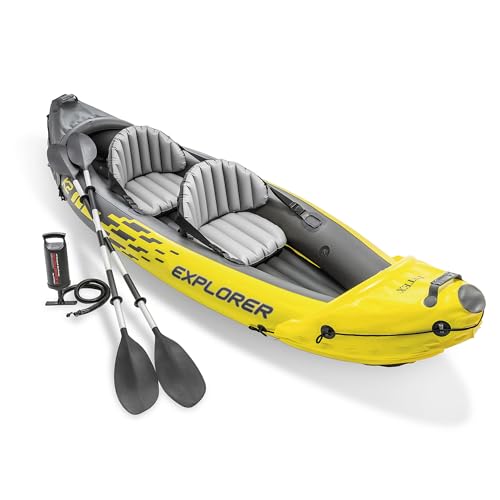
INTEX Explorer K2 2-Person Inflatable Kayak Set with Oars and Pump | 68307EP - Lightweight, Compact, and Portable Kayak with Inflatable I-Beam Floor, Oars, Hand Pump for lakes, mild rivers
As an Amazon Associate we earn from qualifying purchases. Product prices and availability are accurate as of the date/time indicated.

Sunlite Sports Inflatable Kayak 2 Person with Canopy, Portable Inflatable Boat with Shed & Aluminum Oars, Lightweight Tandem Kayak with Air Pump & Carry Bag for Lakes & Rivers, 400 LB
As an Amazon Associate we earn from qualifying purchases. Product prices and availability are accurate as of the date/time indicated.

EKEPE Inflatable Kayak Floating Cooler, 40 QT - River Cooler Float with Tow Rope for Kayaking & Boating, Heavy Duty PVC Dry Storage Vessel Built in Four Cup Holder for Outdoor Enthusiasts
As an Amazon Associate we earn from qualifying purchases. Product prices and availability are accurate as of the date/time indicated.
Ratings are editorial assessments for loaded river camping on gentle water, based on the makers’ published capacities, hatch and bulkhead provisions, and hull classes, and value at typical prices. Capacities are the makers’ published maxima; keep the doctrine’s margin. Prices are typical retail ranges.
The Six River Camping Kayaks Reviewed
1. Old Town Loon 120 — Best Overall
The Loon earns the crown on the loaded doctrine’s own grounds: a hull whose stability, empty or freighted, is the beginner’s confidence made physical; sealed bulkheads fore and aft, so the camp rides in dry cupboards and the boat floats its mistakes; a cockpit that admits the camper and their dignity at the muddy bank; and a maker’s century of river manners in its lines. It is not the cheapest row or the lightest, both conceded; as the boat a river camper grows up in and declines to outgrow, it is the recommendation this guide writes first.
2. Dagger Axis 10.5 — Best Crossover
The Axis is the progressing paddler’s citizen: a hull with genuine river blood — it turns, it edges, it rides the easy rapids with manners the rec boats only rehearse — married to a skeg that civilises the flats and a sealed stern that swallows the camp. Its bow storage is the day-bag’s parish rather than the second hatch’s, stated in its grade; for the camper whose rivers are growing teeth, it is the boat that grows with the skill instead of grading it down.
3. Wilderness Systems Pungo 120 — Best Comfort
The Pungo’s seat is the parish’s legend and its dashboard the camper’s desk, on a hull whose stability has introduced more beginners to loaded paddling than any rival’s. Its hatches seal, its manners forgive, and its day is the six-hour sit performed in something approaching furniture. It concedes the rapids’ ambitions to the Axis with a rec boat’s honesty; for the gentle classics that are the camping river’s heartland, it is the comfort row, and its owners’ decades are its testimony.
4. Perception Tribe 11.5 — Best Sit-On-Top for Warm Rivers
The Tribe’s open deck is the warm parish’s answer: the camp lashed in the tankwell, the swim a pleasure rather than an incident, the re-entry a scramble instead of a rescue — on a hull whose stability is a platform’s. Its camp rides in dry bags rather than hatches, and the cold river is not its country, both stated plainly; for the summer river camper and the angler’s double life, it is the deck this guide recommends with both hands.
5. Crescent Kayaks Class — Best Deck Utility
Crescent’s citizens bring the angler’s deck discipline to the camping parish: capacities with genuine margin, open storage that swallows the crate and the cooler classes, and hulls whose primary stability is a dock’s. They are the heavy parish’s boats, graded with the cart’s necessity implied; for the camper whose river is a highway and whose camp is a household, they carry the most and complain the least in the table.
6. Lifetime Class — Best Budget Entry
Lifetime’s sit-on-tops hold the floor with the floor’s honesty: stability a beginner can trust, a price that starts the parish’s apprenticeships by the thousand, and provisions — the small hatches, the bungees — that serve the gentle river’s overnight with the camp in dry bags and the doctrine’s margins doubled. Their weight, their fittings, and their ceilings are the price’s own statement; as the first boat, bought with the life jacket and the lessons this guide insists accompany it, they have launched more river campers than the flagship rows combined.
Buying Guide: The River Camper’s Boat, Bought Loaded
Step One: Audit the Camp, the River, and the Margin
Begin with the kit’s census, packed and measured in the living room: the sleep system’s compressed volume, the tent’s longest dimension, the water’s plan, the food’s container — the camp as it will actually travel, not as it photographs. Set it against the candidates’ hatch volumes and openings (the tent’s length against the hatch’s diagonal is the classic failed marriage) and against the capacity with the doctrine’s margin kept: the paddler and the camp together at three-quarters of the published figure is the loaded parish’s comfort, and the figure itself is a ceiling, not a target. Then audit the rivers with the same honesty — their classes, their seasons, their portages — and let the gentlest regular river, not the ambition’s exception, elect the hull.
Step Two: The Loaded Audition
Test the finalists as the parish insists: on the water, loaded with sandbags or the camp itself to the trip’s true weight, at a demo day or a rental’s mercy. Perform the river’s own examination — the straight flat mile for the tracking’s tax, the deliberate leans for the secondary stability’s handrail, the turn across the current’s seam, the exit and entry at the bank with the loaded boat — and pack the hatches with the actual kit on the dock, because the boat that fails the packing audition has failed the purchase whatever its manners afloat. The spray skirt, the paddle, and the life jacket are fitted in the same audition, as the system they are.
Step Three: The System Around the Boat
Complete the purchase as the safety frame’s system: the life jacket fitted and worn, of the paddling class whose profile clears the seat back; the paddle sized to the boat’s width and the paddler’s frame, with a spare secured on the longer trips; the dry bags in the hatches’ own sizes; the throw bag and the whistle in their places for the rivers that ask; and the roof or cart system that gets the loaded parish to the water without the shoulder’s grievance. File the first float plan, choose the gentlest river for the maiden camp, and rehearse the capsize’s self-rescue in the warm shallows before the river sets the examination. So audited, auditioned, and systematised, the kayak performs the only service that matters: bend after bend, it carries its camper and their whole small household down the green corridor in dry, stable, unhurried confidence — which is the oldest pleasure in this entire library, and the river has been waiting with it all along.
How We Selected These River Camping Kayaks
We included only real, named, currently sold kayaks whose makers publish capacities, hatch and bulkhead provisions, and hull classes suited to loaded river camping on gentle water. Prices are typical retail ranges. Grades weight loaded stability, sealed storage, and beginner forgiveness above top speed.
Frequently Asked Questions About River Camping Kayaks
What size kayak is best for camping on a river?
The ten-to-twelve-foot parish this table grades, with the reasoning in the hull’s own terms: below ten feet, the volume for a camper and their camp runs out before the hatch does, and the flats become a labour that taxes the day’s pleasure; above twelve, the length that tracks so sweetly on the lake begins to argue at the river’s bends, across its eddies, and around the strainer’s detour, while the portage and the roof rack file their own objections. Within the parish, the choice is the paddler’s honest census — the smaller and progressing toward the crossover’s ten-and-a-half, the comfort-seeking and gentle-watered toward the twelve’s stability and room — and in every case the figure is proven by the loaded audition, because the right size is the one whose loaded waterline floats the camp with the freeboard the riffles respect. The beginner who buys the parish’s middle and loads it by the doctrine will be right for a decade of rivers.
Can I camp from a sit-on-top kayak?
Yes — the warm river’s campers do it by the thousand, and the Tribe and Crescent rows in this table exist for exactly that parish — provided the system’s differences are respected rather than ignored: the camp rides in dry bags on the open deck and in the tankwell, lashed as cargo rather than cupboarded, so the bags’ quality becomes the hatches’ equivalent and is bought accordingly; the paddler rides wetter and higher, which the summer river makes a pleasure and the cold one makes a doctrine of dress (the water’s temperature, not the air’s, sets the clothing, since the immersion the sit-on-top invites must always be dressed for); and the re-entry’s ease, the sit-on-top’s great safety gift, is rehearsed in the shallows like every other skill in this guide. Within those terms the open deck is a legitimate and beloved architecture; outside them — the cold river, the unlashed load — it is the cautionary tale the reviews occasionally file.
How much weight can a river camping kayak really carry?
Less than the headline, by the doctrine this guide has kept throughout: the published capacity is the hull’s maximum safe displacement under ideal trim — the figure at which the boat still floats and functions — and the camping parish’s working load is three-quarters of it, counted honestly: the paddler dressed, the water at its tyrant’s full weight, the camp, the safety kit, and the day’s food, summed on the bathroom scale’s parish rather than the memory’s. The symptoms of the spent margin are the audition’s curriculum: the freeboard shrunk to a hand’s breadth, the hatches’ seams awash in the riffles, the turns gone sullen, the stability’s handrail lowered — each a message that the load, not the river, has become the hazard. The camper who audits the camp’s weight as a budget — the lighter tent, the filter against the carried gallons, the food’s discipline — buys back the margin that is the boat’s real safety equipment, and finds, as every loaded parish discovers, that the lightest camp is also the pleasantest to pack, portage, and paddle.
Do I need a spray skirt for river camping?
For the sit-inside boats, on any river with a pulse, the doctrine’s answer is yes — and its reasoning is the loaded boat’s own physics: the camp’s weight deepens the hull and lowers the cockpit’s rim toward the water, so the riffle’s chop and the eddy line’s splash, which the empty boat shrugged at the deck, now arrive at the opening where the paddler sits, and a cockpit taking water is a stability problem compounding by the litre. The skirt — sized to the cockpit’s rim, fitted, and rehearsed for its release until the wet exit is a boring skill — keeps the parish dry and the boat’s manners intact, and its companion disciplines are part of the purchase: the grab loop out, always, and the rehearsal in the warm shallows before the river’s examination. The glass-flat river of a summer’s evening is the honest exception, where the skirt rides the deck as an option; the camping river with rapids in its description, however gentle, is not, and the beginner’s kit list should write the skirt beside the life jacket in the column headed always.
Related guides
- Best Walkie Talkies for Camping and Kayaking in 2026: Midland, Motorola, Cobra, and Rocky Talkie Radios Compared for Waterproofing, Honest Range, Floating Designs, and Keeping a Group Together on Land and Water
- Best Lithium Battery for Camping in 2026: Lithium Battery for Camping, Lithium Camping Batteries, and Best Camping Batteries
- Best Camping Kayaks Under 500 in 2026: 7 Best Camping Kayaks Under 500 Dollars That Are Stable, Roomy, and Built for Camping
- Best Stove for Kayak Camping in 2026: 7 Best Stoves for Kayak Camping That Are Light, Compact, and Boil Fast
More from Amazon
Programs that pair well with the guide above. Offers and eligibility are set by Amazon and may change.
Free shipping on eligible items, Prime Video and more. Eligible new members can start with a free trial.
Start a Prime free trialA Prime membership for ages 18-24 with a trial period. Eligibility is set by Amazon.
See Prime for Young AdultsAudiobooks and podcasts to listen to on the go. Eligible new members can start with a free trial.
Try Audible freeAd-free music streaming. Eligible new subscribers can start with a free trial.
Try Music Unlimited freeAs an Amazon Associate we earn from qualifying purchases.

Write Your Review
No reviews yet. Be the first to share your experience!